
Secondary Watercolor Palettes
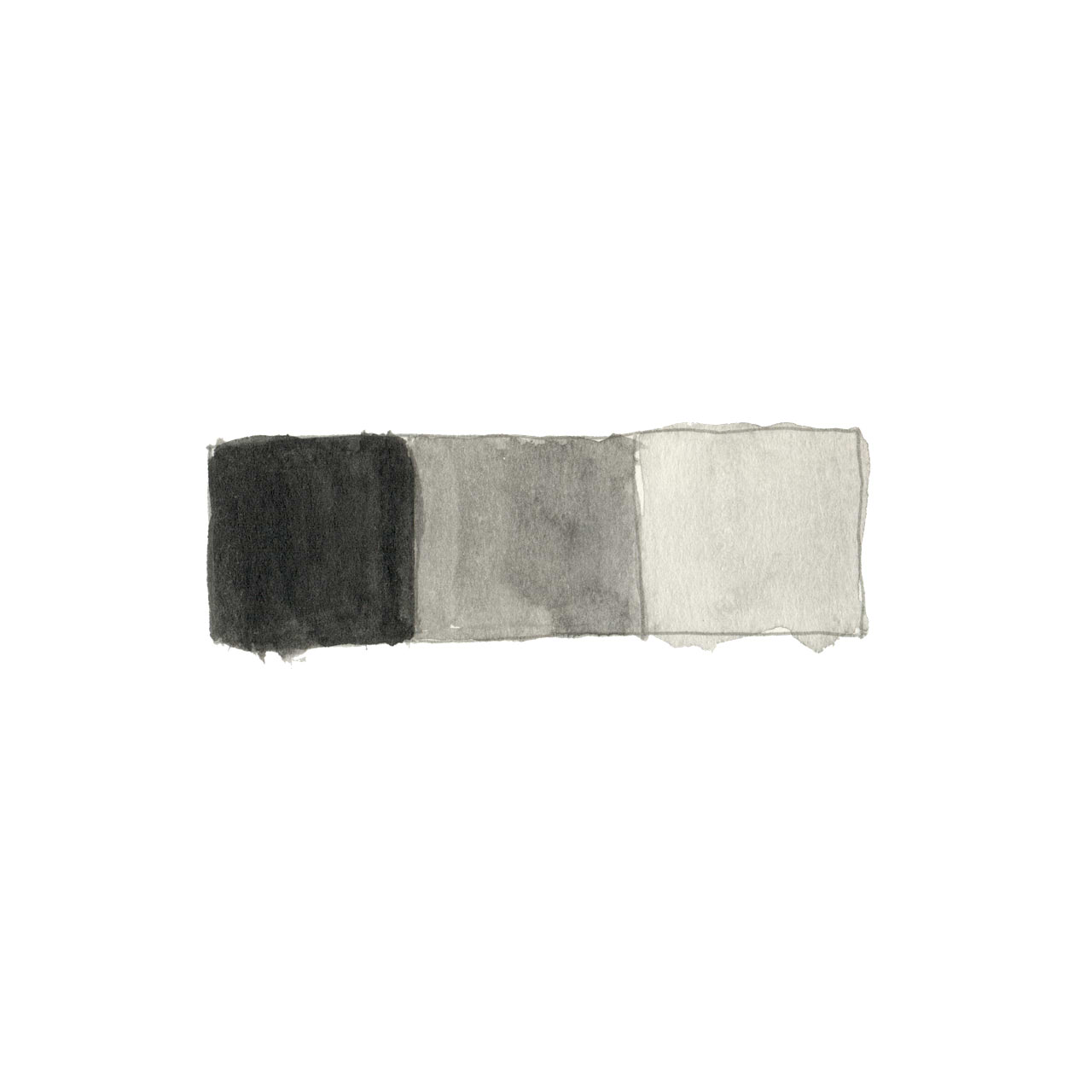
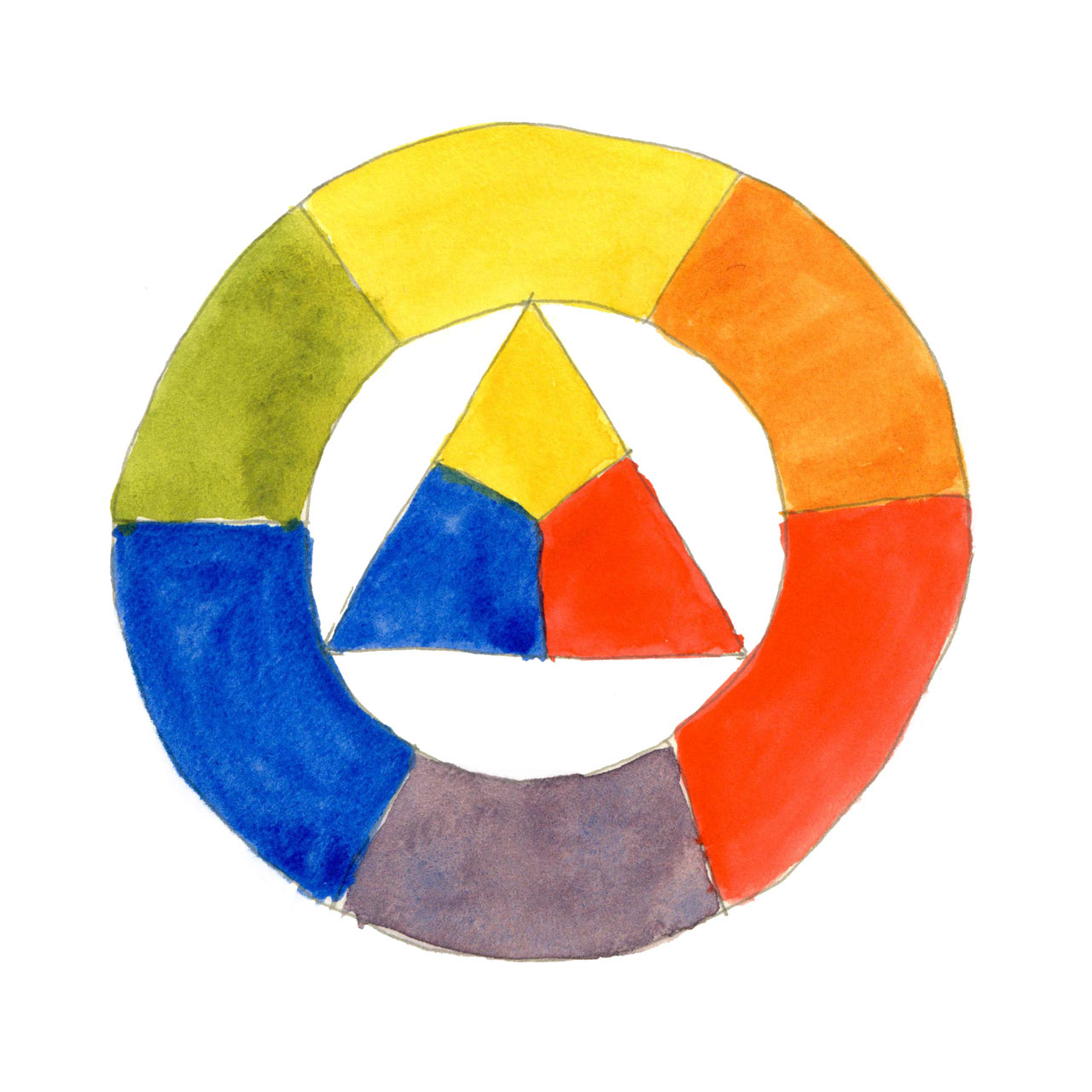
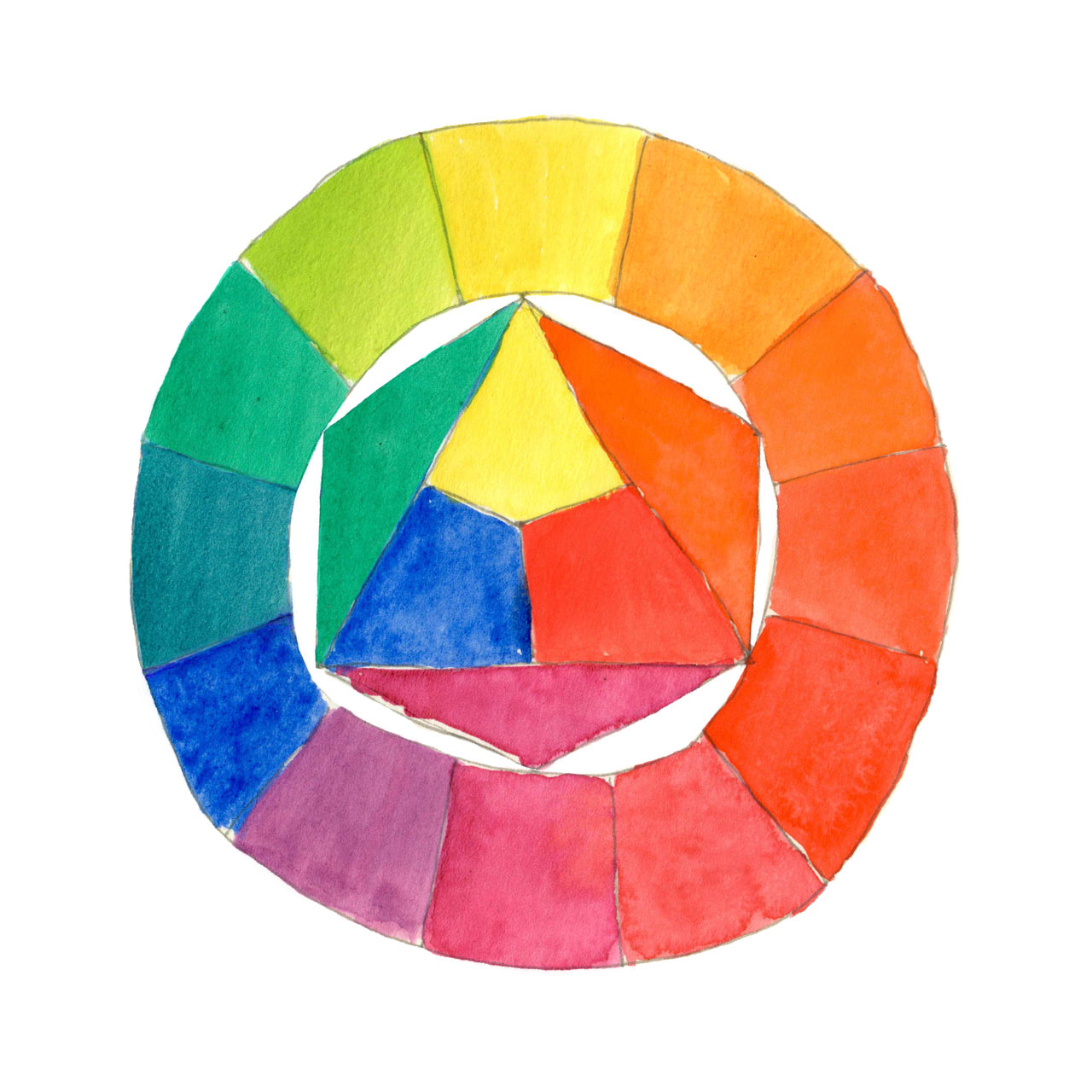
A 1-color, 3-color, and 6-color watercolor palette.
Secondary palettes use 3 primary colors (usually a warm red, a warm yellow, and a warm blue), along with 3 or 4 secondary colors (usually a warm green, a warm magenta, a cool blue, and/or a cool orange.) They're great if you want a vibrant and wide range of colors with a small number of paints.
This post builds up to a full set of them in watercolor. Along the way, I'll also share some advice on setups and non-paint supplies that could make painting easier for you, as well as exercises you can do at each stage to test your knowledge about this medium.
Do note that I am based in the United States, and buy my art supplies online from Blick, Walmart, Staples, St. Louis Art Supply, Talas, Jackson's Art, and Meeden Art. Some of these items may be more expensive or unavailable in other countries and stores. Apologies in advance! (I have listed alternatives where I can.)
Also, here's a spreadsheet version for the spreadsheet fans.
This post will be periodically updated to fix typos and small informational mistakes. If you catch any, please let me know in the comments!
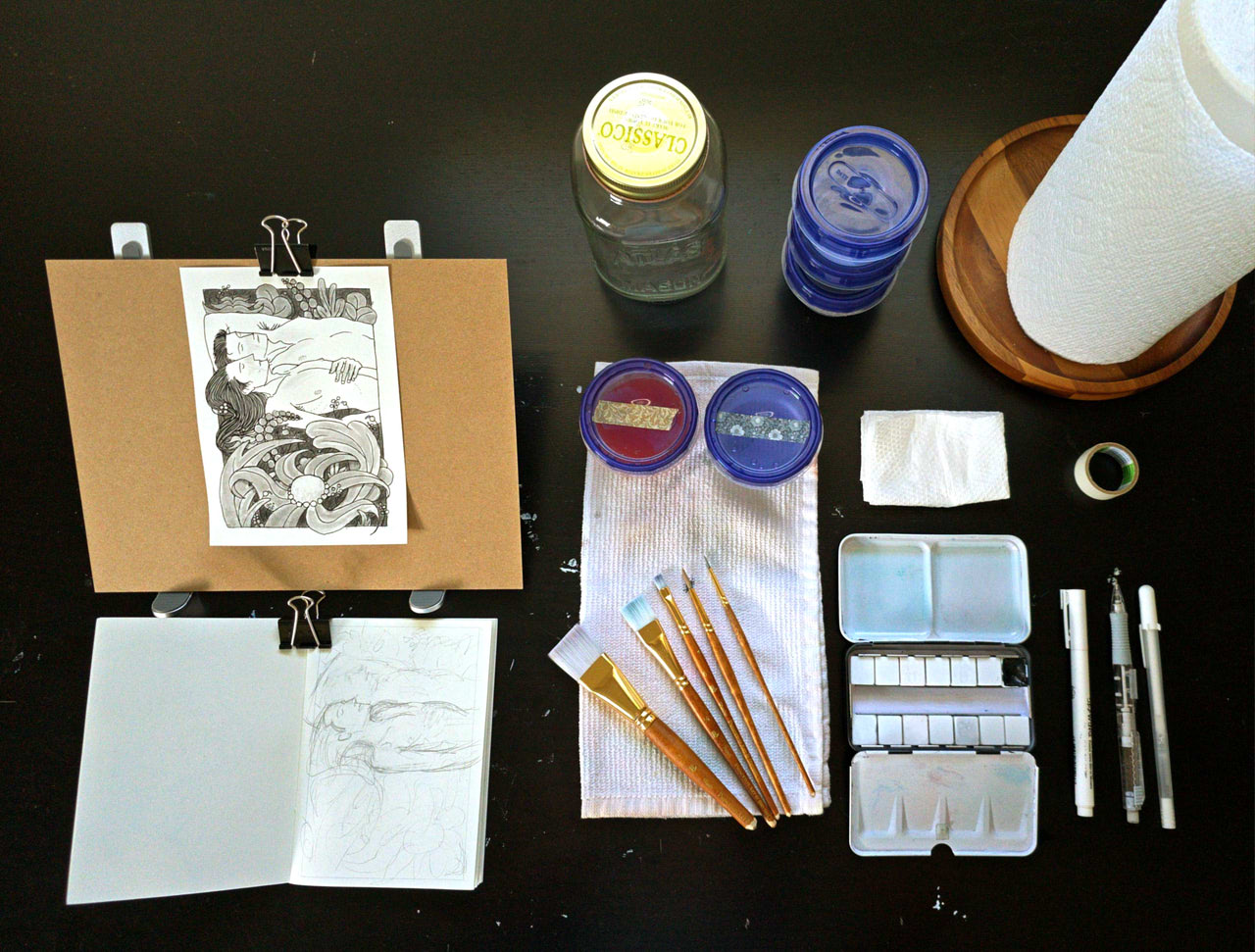
The supplies listed in the 1-color stage, laid out in a way that is recommended for right-handed people. Left-handed people should mirror the layout.
A 1-Color Palette
Goals: See all of the supplies you need for trying out watercolors, and then start experimenting with them.
Required supplies (more info below): Paper, brushes, a watercolor tin, 1 watercolor paint, water cups, and paper towels.
Required non-paint supplies
Paper: Strathmore 400 Heavyweight Drawing Pad, 9x12 in., 163gsm, 24 pages.
This wood pulp paper is what I use in watercolor sketchbooks and color tests. It is technically not intended for that, but I find that it can handle many washes quite well. Just don't scrub/lift paint too hard, or it will "pill" up a bit, like an old yarn sweater.
You can subdivide the paper up into 6x9 in. or 4x6 in. panels, or take out the pages and make a saddle stitch sketchbook.
Do note that this is an off-white, almost yellowish paper.
If you prefer non-spiral bound sketchbooks, I hear good things about Talens Art Creations sketchbooks. The Art Deco cover versions have white paper instead of off-white paper.
Less expensive variant: Strathmore 400 Drawing Paper, 4x6 in. 130gsm, 24 pages.
Note: This is thinner, smaller paper. Still good in my experience, will just wrinkle more with heavy washes. (The color wheels in this post were done on it!)
Brushes: Princeton Real Value Brush Set, 9144, white taklon, set of 5.
I've used this brush set for over a decade with oil paint, acrylic, watercolor, gouache, and ink. I really like them! Make sure to wash them with soap (ideally The Masters Brush Cleaner) and water after each use, and dry them horizontally on a towel so the pigment doesn't get stuck in the ferrule. Also, don't mix brushes you've used with oil paint with any other medium.
Less expensive variant: Princeton Real Value Brush Set, 9174, white taklon, set of 5.
Note: Same fibers, but smaller brushes than the other set.
Watercolor tin: MEEDEN small watercolor tin, includes 14 empty half pans.
You technically don't need a tin, as a white porcelain kitchen plate works just fine. However, a tin gives you a place to neatly mix, store, and transport dried out paint, so you're not wasting as much of it over time.
If using a plate, don't eat on it afterwards. Designate it to be your watercolor plate. Besides the fact that you shouldn't ingest any kind of paint or paint residue, the plate itself may get stained with use.
Water Cups
You really can use anything for water cups, though I personally like these 4oz stackable screwtop containers. (Do note that they are not 100% leakproof if you plan on traveling with them, despite what it says on the label.)
At minimum, I'll use two to separate cool-tinged and warm-tinged water, though I also like to separate white-tinged, black-tinged, and fresh water.
I also use a large wastewater jar (in my case, an empty tomato sauce jar) to store dirty water during longer painting sessions. It's not necessary if you're using larger water cups or frequently emptying them out in the sink, though.
Paper towels (or a reusable cotton towel)
Great for resting your brushes on while working. Also great for reducing the amount of water on your brushes.
You can use whatever you have on hand. I have both disposible paper towels and small reusable cotton towels on my desk. (Get cotton towels in white so the lint doesn't show up too much on your paintings!)
Paint
Black: Lamp Black, Winsor & Newton Professional Watercolor, 5ml tube.
Pigment number: PBk6
Great for value studies (like this one done in preparation for a color postcard) and stylish grayscale paintings.
A little goes a long way, so only use small bits of paint at a time. Of course, you will have to use more paint (and even apply multiple layers) when you want darker values, but you may be surprised at just how pigment-rich watercolors can be.
To make a dried pan, squeeze out a small layer (hardly 1/8th of an inch, or 3 cm.) Wait for it to dry over a day or two, and then squeeze in some more. It will take about a week to fill a pan, but I think this is faster and neater than filling it all at once.
To reactivate the dry paint, put a drop of water on it with your brush, or spray it lightly. Wait for 30 seconds, and then use a wet brush to pick up some paint. It is best to dilute paint further in the mixing areas of the watercolor tin, as opposed to in the paint pans.
A 5ml tube can fill 2 to 3 half pans.
Less expensive variant: Lamp Black, Winsor & Newton Cotman Watercolor, 8ml tube.
Note: I don't actually have experience with this line of paints. Cotman is considered their "student" grade brand. It just means there might be more paint binder, less pigment, and the pigment types may be more economical than their professional line. What that means for you is that it may be hard or impossible to get extremely dark versions of some colors.
Optional supplies you might already have
A mechanical pencil with refillable leads and long erasers. Good for sketching out your idea without having to carry a separate sharpener or eraser. I like Pentel Quick Clicks, but you can use whatever mechanical or non-mechanical pencils you have already.
A waterproof black pen. Nice for differentiating from your pencil drawing. A 0.25mm Pigma Micron is pretty good, but you can get a thicker line width or brush pen instead. Just make sure it says "waterproof" and something like "pigment-based" or "archival" on the pen, as non-waterproof and dye-based markers may bleed when you apply watercolor over them.
A white gel pen. Nice for adding small white highlights at the end. I like the bold tip Sakura Gelly Roll pens.
A paper towel roll holder. Not necessary, but makes it easier to grab paper towels while working. Also makes you feel more like a professional.
A hardboard to tape paper on. You can use any rigid (and ideally impermeable) surface instead of hardboard, though you'll specifically want to look for a tape with low tack so it doesn't damage the paper too much when you remove it. I use acrylic sheets and laminated chipboard, but these Richeson hardboard sheets are pretty good. As for tape, I like 3/4 in. Holbein Soft Tape, and washi tape.
An adjustable stand. I like this foldable aluminum stand a lot. It works best with hardboards and sketchbooks under 9x12 in., though I have also used it with 11x14 in. boards.
Medium-sized binder clips. I use these to keep sketchbooks opened or closed. I also clip on paper to boards when I don't want to use tape, and clip things like my watercolor tin and paper towels to sketchbooks with them. Here's a 12 pack of them.
Total cost
On September 2026, before shipping and taxes:
$15 for required supplies only (less expensive variants.)
$46 for required supplies only.$48 with all optional supplies (less expensive variants of required items.)
$74 with all optional supplies.
Online shipping and taxes may add $7, $14, $21, or more to your total, depending on how many stores you purchase from, and where you live.
Suggested exercises
- Swatch your black watercolor (opaque & watered down versions.)
- Play around with different consistencies of paint.
- Paint a window in a room at 3 different points in the day.
- Learn about watercolor pigments in preparation for the next stage.
- Before continuing, you should be able to answer questions like:
- "What is the pigment number index?"
- "What pigment number is Lamp Black?"
- "What is the difference between a pigment and a dye?"
- "What is drying shift?"
- "What is the paint binder for watercolor?"
- "What does it mean when a pigment is staining, or granulating?"
- "What kinds of pigment opacities are there?"
- "What is wet-on-wet?" (a.k.a "wet-into-wet")
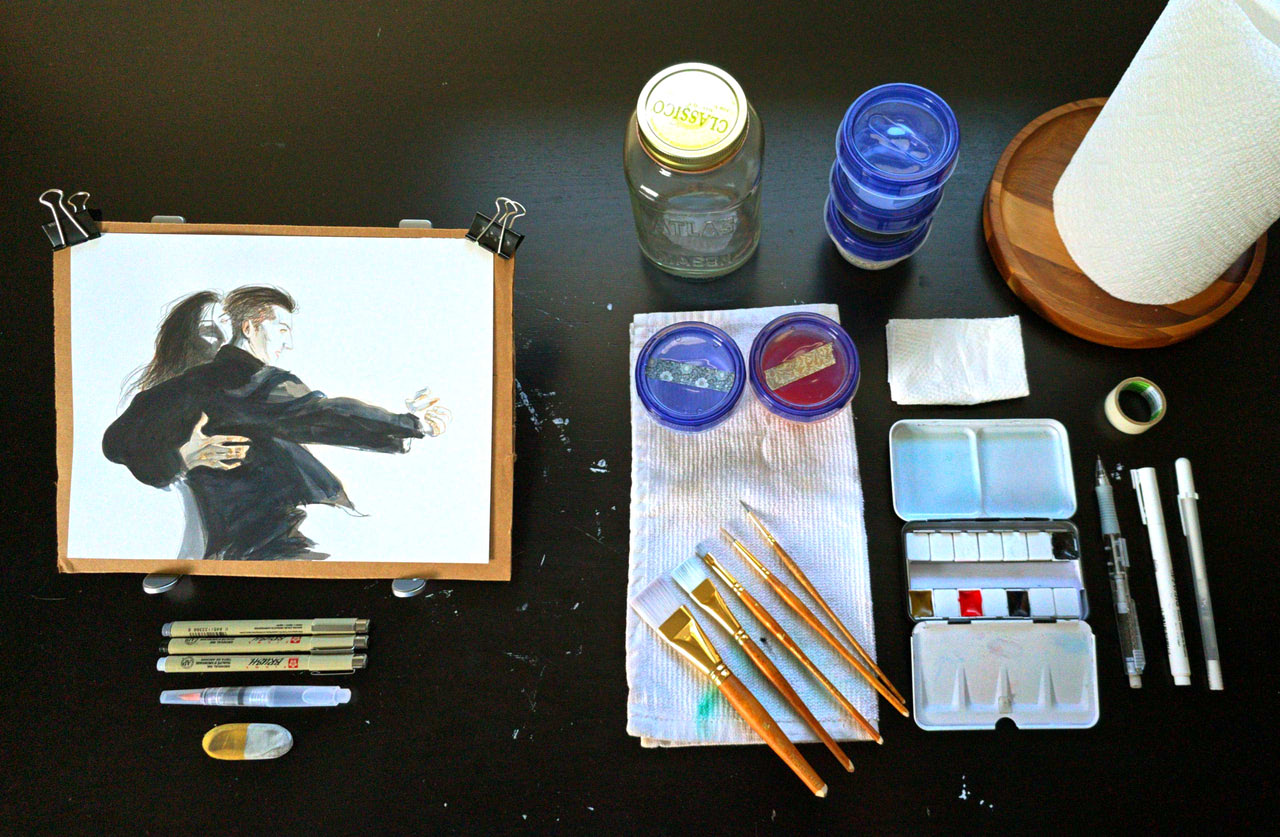
The supplies introduced in the 3-color stage. New pens, a water brush, a large eraser, and 3 new paints have been added.
A 3-Color Palette
Goals: Expand your watercolor palette, understand the strengths/limitations of different paint choices, add new dry media, and try out cotton paper.
New required supplies: Cotton paper, and 3 new paints.
Required non-paint supplies
Paper: Legion Stonehenge Spiral Pad, 7x7 in., 250gsm, 32 pages.
Note: The 9x12 in. variant is more expensive, but I like it because it has enough space for 2 5x7 in. paintings on each page. (This almost doubles the amount of paper you get on it vs. the 7x7 in. pad.)
(Cue very long section. Paper is important in watercolor painting!)
This 100% cotton paper was originally meant for printmakers, but it is also widely used for graphite, colored pencil, ink, and watercolor work.
Technically, it is slightly thinner than you usual watercolor paper, at 250gsm instead of the more common 300gsm. It is also smooth-ish. Legion calls this texture "vellum", and in watercolor terms, this is more like a hot press paper (as opposed to cold press and rough papers, which have more texture.) I do not find either of these things to be a problem, as you can tape the paper on a board to reduce warping, and interesting watercolor qualities like pigment granulation still show up on it.
The advantages of cotton paper that is geared towards watercolor painting are twofold. First, cotton watercolor paper tends to be more resilient to scrubbing and lifting. Second, these papers are guaranteed to have "sizing." Sizing is a substance applied in and/or on the paper that slows down how fast water and pigment can sink into it. "Soft sized" papers (a category which Stonehenge and many hot press papers fall into) absorb things at a normal to fast rate, and "hard sized" papers (like Arches, and many cold press papers) absorb things at a slow rate, or almost not at all. Hard sizing can allow you to blend wet paints for longer, and colors are reported to look more vivid, as the pigment stays mostly on the surface of the paper instead of entirely sinking in.
Watercolor is distinguished from similar mediums like gouache not only because of its translucency, but also because the pigment particle size is finer and will sink more into the paper fibers. While this gives it a uniform, matte finish at the end, matching that of the paper, it also means that watercolor will look and handle very differently across varieties of paper. Gouache, on the other hand, has a larger pigment particle size, and the paint sits more on the surface of the paper. It generally looks the same on all papers, but will have a noticeably different texture than the paper itself when applied thick (a chalky/matte texture that is easy to scratch.)
I personally don't use hard sized or cold press paper (known as NOT in the UK), but I hear good things about Arches if that's what you're looking for. It's apparently very hard sized, and the cold press and rough patterns seem more "random" than the uniform ones I've seen on other brands (... even on ones I love as hot press, like Saunders Waterford.)
Something to note: I think Stonehenge paper is hard to find outside the US. You can try Baohong, Meeden, Arches, Fabriano, St. Cuthbert's Saunders Waterford, Winsor & Newton, and Strathmore 500 for 100% cotton watercolor paper. These companies also tend to have more affordable 25%/50% cotton varieties of watercolor paper.
Less expensive variants:
- Legion Stonehenge Mini Drawing Pads 2.5 x 3.74 in., 250gsm, 15 pages.
Note: The same paper, just in a smaller format. Good for sampling if you like Stonehenge, and seeing all of the colors they have.
New paints
Yellow: Transparent Yellow, Winsor & Newton Professional Watercolor, 5ml.
Pigment number: PY150 (also known as Nickel Azo Yellow.)
A non-granulating, staining yellow. Warm-toned, as opposed to yellows that are more green-ish, like Bismuth Yellow, or ones labeled "lemon" and "chartreuse." Has a dark, nearly greenish gold masstone (thick application of paint) and bright yellow undertone (thin, watery application of paint.)
Less expensive variant: Gamboge Hue, Winsor & Newton Cotman Watercolor, 8ml tube.
Note: "Hue" stands for an approximation of another commonly used pigment. Usually made by mixing two or more pigments, and/or a pigment that is similar to but less expensive than the target pigment.
Red: Winsor Red, Winsor & Newton Professional Watercolor, 5ml tube.
Pigment number: PR254 (also known as Pyrrol Red.)
A non-granulating, slightly staining red. Cool-toned, as opposed to yellows that are more orange-ish like Cadmium Reds, or ones labeled "scarlet." Similar hue in masstone and undertone.
Less expensive variant: Cadmium Red Hue, Winsor & Newton Cotman Watercolor, 8ml tube.
Note: A warm red.
Blue: French Ultramarine, Winsor & Newton Professional Watercolor, 5ml tube.
Pigment number: PB29 (also known as Ultramarine Blue - Red Shade)
A heavily granulating, non-staining blue. Usually warm-toned (when labeled "French Ultramarine" or "Red Shade"), in contrast to Phthalo Blue (Green Shade), Cerulean, Prussian Blue, and blues labeled "turquoise."
Less expensive variant: Ultramarine, Winsor & Newton Cotman Watercolor, 8ml tube.
Note: Same pigment! Yay.
Optional supplies you may already have
Water brush: Large Sakura Koi Water Brush
I actually have the Sakura Koi brushes with 4ml tanks, but they're a little hard to find, and I think the larger reservoir will be more useful and comfortable for most people.
With that out of the way, I am introducing water brushes here for two reasons. One is that you may start wanting to sketch outside at this point. Water brushes make that convenient, as you do not have to carry water jugs with you, just a few paper towels to clean your brush on. Another reason is that it's a little hard to control the amount of water on these brushes. You get used to it, but it might scare off beginners.
You can use water brushes indoors, too. I like to use them at the end of the day when I just want to sketch something quick and don't want to set everything up. They're also nice for softening and blending edges.
Very important: You'll want to disassemble and fully dry water brushes every 2 weeks or less to prevent mold from building up inside of it. You can look up tutorials on how to disassemble them and/or wash them out with white vinegar on Youtube. Some water brushes (usually the more expensive ones with push buttons on the barrel) cannot be fully disassembled. Even though those feel nicer to use, I prefer being able to easily disassemble and clean water brushes.
A large eraser
This'll make your life easier when erasing larger and more intricate drawings. You can use what you have. I like to rub the large flat side on the paper lightly when I want to remove most but not all of the sketch. (If the eraser shavings annoy you, you can get a kneaded eraser instead.)
Dry Media: Other waterproof markers, and/or colored pencils.
Pigma markers (and other waterproof markers) come in a wide range of colors and sizes. I like using the grayscale ones, the brush pens, as well as a few colors like blue and brown.
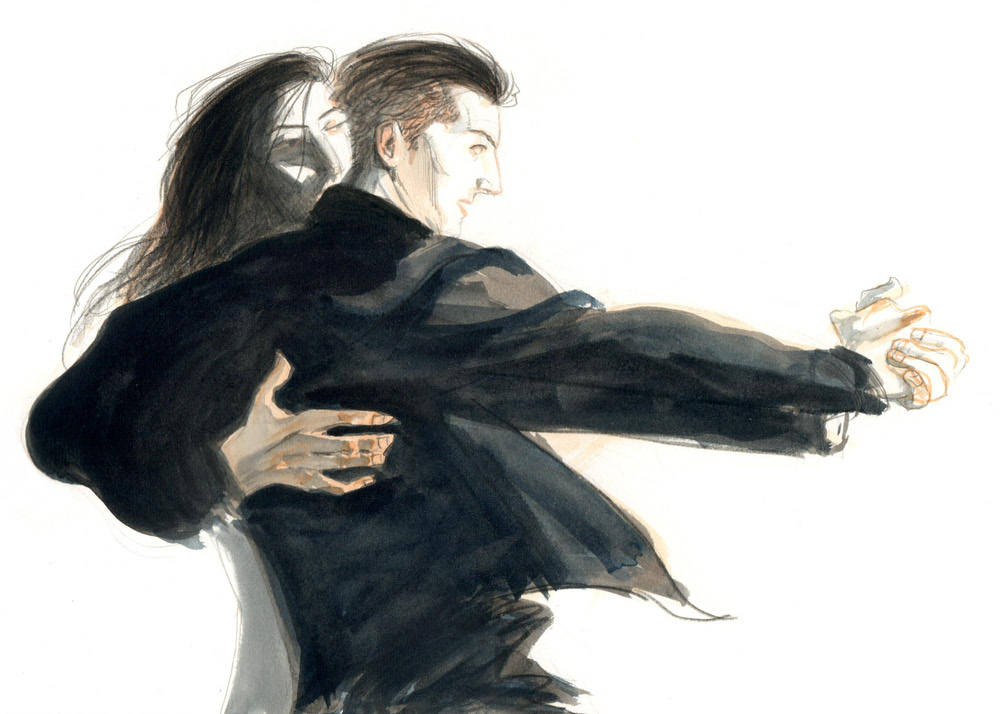
You can also try water-soluble (and regular non-water soluble) pencils. The painting at the top of this section uses a black water-soluble pencil in the hair and shadowed face of the left figure.
Total cost
On September 2026, before shipping and taxes:
$14 for required supplies only (less expensive variants.)
$42 for required supplies only.$19 with all optional supplies (less expensive variants.)
$47 with all optional supplies.
Online shipping and taxes may add $7, $14, $21, or more to your total, depending on how many stores you purchase from, and where you live.
Suggested exercises
- Create a color wheel like the one shown at the top of this post.
- Layer paint onto dry vs. wet paper.
- Try mixing paints thoroughly on the palette before applying them to the paper, and then try the opposite (laying a wash of one color, then adding another on top of it.)
- Understand the strengths and limitations of this palette before moving onto the next stage.
- Paint another window at 3 different times in the day.
- Before continuing, you should be able to answer questions like:
- "What qualities do these new colors have? (Granulating, staining, opaque, transparent, etc.)"
- "Are these new colors considered 'warm' or 'cool'?"
- "Why can't I mix very bright purples or greens?"
- "How can I mix brown or gray without black?"
- Some important readings for the next section:
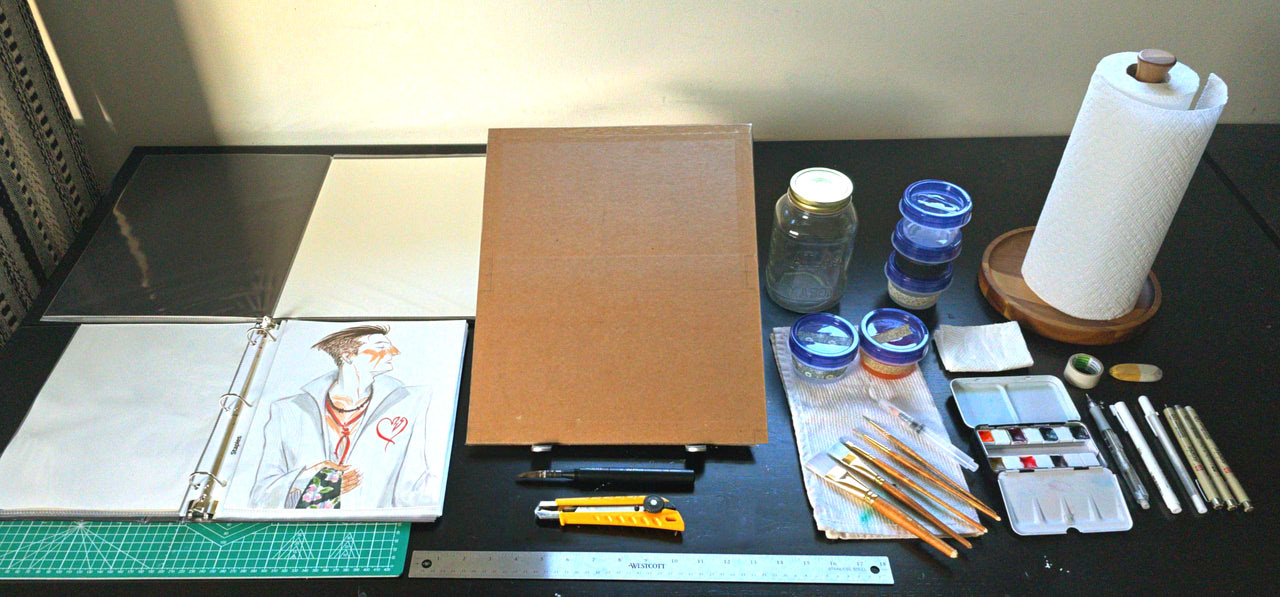
The supplies introduced in the 6-color stage. This stage focused in large part on how to cut and store large sheets of watercolor paper, though it also introduces a quill brush and 3 new paints.
A 6-Color Palette
Goals: Add secondary colors, understand split primary vs. secondary palettes, and see if buying watercolor paper in large sheets makes sense for you.
New required supplies: 3 new paints.
"Required" non-paint supplies
Note: Beyond this point, none of the non-paint supplies are really "required." For example, though it may be cheaper to buy watercolor paper in sheets, you may not have the space, time, skill, or resources to cut down a large sheet of paper. Portfolios and quill brushes are also quite expensive.
In fact, I mostly recommend these cutting and storage supplies if you will also use them for other things like bookmaking, postcard printing, selling originals, and other painting mediums. Unless you are extremely dedicated to watercolor, the "startup" cost may be too high for what it'll be worth to you.
A synthetic squirrel quill brush
A synthetic brush uses fibers that imitate natural hairs, like squirrel or kolinsky. Natural and synthetic squirrel hair brushes are useful when watercolor painting because they are able to pick up and release more paint than Taklon brushes. Because of their construction, quill brushes in particular can hold a lot of paint/water, as well as take many shapes, from having extremely thin points, to becoming nearly shaped like flats.
I personally use the Casaneo Travel Quill as it is convenient to be able to carry it around without a brush case, though the non-travel version is less expensive.
I don't think it's absolutely necessary to use a fancy synthetic squirrel quill brush. While it can replace most of my brushes during daily use, I still find myself reaching towards my old Taklon flat brushes for certain effects, like the stylized wave lines in the river on this painting.

Paper: Saunders Waterford Watercolor Paper, 22" x 30", White, Hot Press, 425gsm
A watercolor paper that is slightly thicker than other watercolor papers, at 425gsm instead of the usual 300gsm. Weights above 300gsm tend to be hard to find on pads (sketchbooks that are glued on one edge only) and blocks (sketchbooks that are glued on four edges, with a small gap on one edge to slip a tool to cut the glue under.) I also like their 600gsm paper for works that are 11x14 and larger.
It's absolutely not necessary to buy thick watercolor paper, even when working large. Thick papers (and hot press paper) also tend to absorb water very fast, making it harder to seamlessly apply washes. However, I use this paper as an example of something that is hard or impossible to find in sketchbook format, and which may be less expensive to buy in Full Imperial (22x30) sheet format.
Cutting Mat: Blick Cutting Mat - Gray/Black, 12" x 18"
I find that a 12x18 cutting mat is large enough to cut these 22x30 sheets. I just have to make sure my blade is on the mat at all times. I also recommend this size because even if you decide you don't like 22x30 sheets, you can still use this cutting mat for smaller paper, and store it pretty easily.
There are 18x24 and 24x36 variants available as well, if you have the desk space, and would like to make cutting down large sheets easier.
Utility Knife: Olfa Ratchet-Lock Utility Knife
I recommend utility knives as you can snap off segments of the blades and get a fresh edge when you need it. A dull edge will make cutting harder, and will give you unintended ragged edges.
Nonslip Metal Ruler: Wescott Flexible Stainless Steel Ruler, 24"
To cut down a 22x30 sheet into quarters, start by measuring out 15 inches along the long edges. Then, place your ruler so it lines up with those marks. Press down firmly on the ruler with one hand, and cut along it with the utility knife. For heavier papers, it's best to do multiple passes. Measure 11 inches on the new long edge, and cut again. You can now use these 11x15 sheets as is, or trim them down to the more standard frame and portfolio size of 11x14.
Portfolio: Itoya Original Art Profolio - 11" x 14", 24 pages
Useful for storing large blank pages and finished work. If you're going to work on sheets that are printer paper sized and smaller, a regular 3 ring binder with plastic sleeves will work fine.
If you want to avoid plastic, you can also cover and store paintings with glassine paper.
The ultimate storage setup would involve acid-free & archival mats (to prevent contact between the painting and interleaving paper), backing boards (to offer rigidity), interleaving papers (to separate invidiual works if not stored in a binder), and boxes/drawers (to keep everything all in one place), but that is extremely expensive and beyond the scope of this post.
New paints
Orange: Winsor Orange (Red Shade), Winsor & Newton Professional Watercolor, 5ml.
Pigment number: PO73 (also known as Transparent Pyrrol Orange.)
A non-granulating, semi-staining orange. Cool-toned, closer to red than oranges that have strong yellow undertones. Very difficult to capture in scans how bright and strong this orange feels, especially when compared to the more muted orange that Nickel Azo Yellow and Pyrrol Red create.
Less expensive variant: None?
Note: I haven't found any great budget options for this one that are also lightfast. However, If you're using Cotman Cadmium Red Hue (the less expensive variant of red listed above), you should have less issues mixing bright oranges as it is a warm red. You can probably skip out on this one in that case.
Magenta: Quinacridone Magenta, Winsor & Newton Professional Watercolor, 5ml tube.
Pigment number: PR122 (same pigment and brand name usually.)
A non-granulating, staining purple. Warm toned, as opposed to purples that are more blue-ish like Dioxazine Violet. Similar hue in masstone and undertone.
Less expensive variant: Mauve, Winsor & Newton Cotman Watercolor, 8ml tube.
Note: It seems close enough to Quinacridone Magenta, even if it has some Dioxazine Violet included.
Green: Winsor Green (Blue Shade), Winsor & Newton Professional Watercolor, 5ml.
Pigment number: PG7 (also known as Phthalo Green - Blue Shade)
A non-granulating, legendarily staining green. Your white brushes will become green after a while because of it. The blue shade is my personal favorite as it creates nice dark turquoises with ultramarine (and incredibly bright turquoises with Phthalo Blue - Green Shade.)
The greens it makes with Nickel Azo Yellow are bright enough for me, but you can go with the yellow shade of Phthalo Green if you want even more saturated, dark, warm greens.
If you want cool but bright, almost "highlighter"-y greens, you will need a strong, cool yellow like Bismuth Yellow.
Less expensive variant: Viridian Hue, Winsor & Newton Cotman Watercolor, 8ml tube.
Note: Same pigment! Yay.
Optional supplies you might already have
A paper organizer
Organizers with multiple horizontal tiers are useful for storing palettes, brushes that are drying, hardboard for painting on, watercolor pads/blocks, and binders with loose sheets of paper in them.
The metal mesh ones can be quite expensive these days (~$25 and more), but i find them to be invaluable for saving space on my desk and keeping neat. (I also use them for drying 9x12 in. and smaller oil paintings!)
A 3-ring binder with plastic sleeves
If you're not going to work on large sheets of paper, you don't need to buy a specialized portfolio like the ones Itoya makes. You can go to any office supply store and pick up a 3 ring binder with plastic sleeves to use instead. There are all sorts of binder sizes and types of inserts available these days, like mini binders and plastic sleeves with multiple slots for 4x6 or 5x7 papers.
If you want to avoid plastic, you can also cover and store paintings with glassine paper.
Total cost
On September 2026, before shipping and taxes:
$8 paints only (less expensive variants.)
$22 for paints only.$57 with all optional supplies (less expensive variants.)
$148 with all optional supplies. (Ouch...)
Online shipping and taxes may add $7, $14, $21, or more to your total, depending on how many stores you purchase from, and where you live.
Suggested exercises
- Seek out new learning material (videos, posts, textbooks) on your own, ex.: "Learning Color Through Paints" by Bruce MacEvoy.
- Make an updated color wheel.
- Mix colors that are directly across from eachother on the color wheel. Some (like Phthalo Green - Blue Shade and Pyrrol Red) will turn into gray, but others (like Ultramarine Blue and Pyrrol Orange) won't!
- Paint another window at 3 different times in the day.
Beyond Secondary Palettes
This really is only the tip of the iceberg when it comes to watercolor.
For instance, this palette features only one granulating color, which is Ultramarine. PR108 Cadmium Red, PV15 Ultramarine Violet, PG18 Viridian, PR233 Potter's Pink, and many earth pigments like Yellow Ochre, Raw Sienna, Burnt Sienna, and Venetian Red are popular on watercolor palettes for their granulation.
It is also is not necessary to have such vibrant colors. The secondary palette is helpful for teaching what needs to be done in order to get as wide of a range in a palette as possible, but it may not always be your aim to paint that vibrantly.
You can paint something equally as interesting with one or two colors vs. six. You can also take the principles of a secondary palette (red, yellow, blue, plus 3 secondary colors), and apply it to very muted paints, like ones that use earth pigments.
Paints are also not the only thing that makes watercolor painting interesting. It can be equally fun to improve your setup for painting outdoors, figuring out how to use the medium for sketches vs. large finished works, and so on. Even seemingly "boring" things like suddenly getting a feel for exactly how much or how little water you need on your brush can be quite rewarding.
Again, I hope this palette (and post in general) just gives you a good framework for solving questions you may have about watercolor as a beginner. I am by no means a teacher, but the confusion I felt and the Endless Research and Experimentation I did when I started painting with this medium remains fresh on my mind, in part because I am still learning every day... more out of curiosity than pure inexperience, though. (You could say that this guide was written in a way that I hope could answer past-me's questions.)
Anyway, final note: it's good to be informed about your materials, but even better to start painting. So, go paint!
Corrections & Updates
- 2026/09/19: Added "Learning Color Through Paints" by Bruce MacEvoy as a suggested reading for the 6-color stage.
- 2026/09/19: Added a note about the "ultimate" archival storage solution in the 6-color stage.
- 2026/09/19: Added a note about glassine as a plastic-free option for storage in the 6-color stage.
- 2026/09/19: Added a note about paper organizers in the 6-color stage.
- 2026/09/19: The magenta in the intro of the post is now correctly described as warm-toned.
- 2026/09/19: Pigment number listed under images for Pyrrol Orange has been fixed to PO73.