The Golden Net
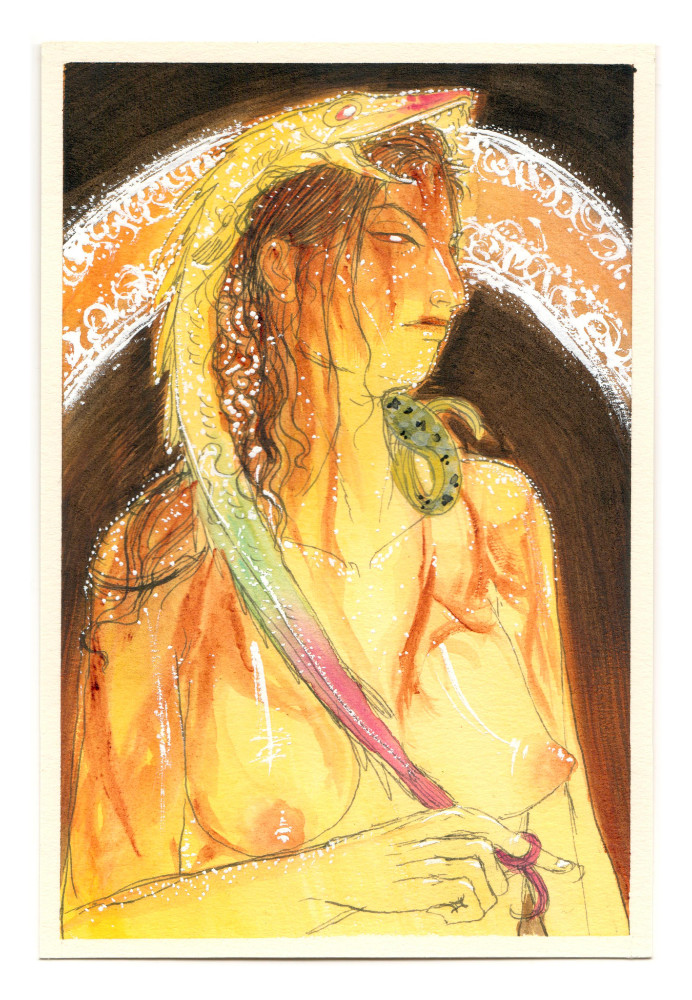
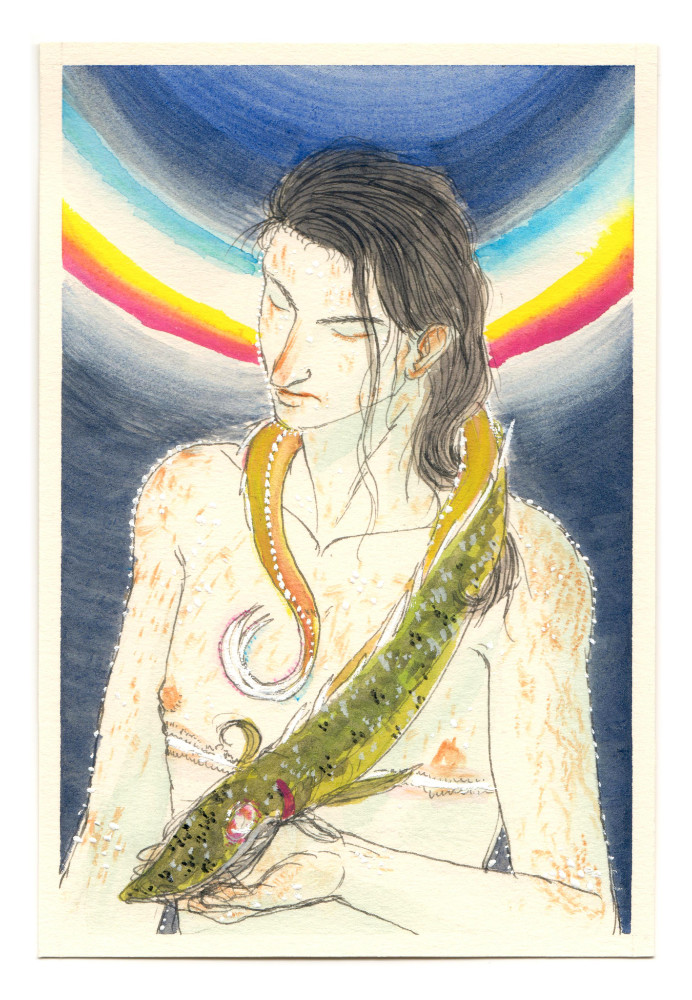
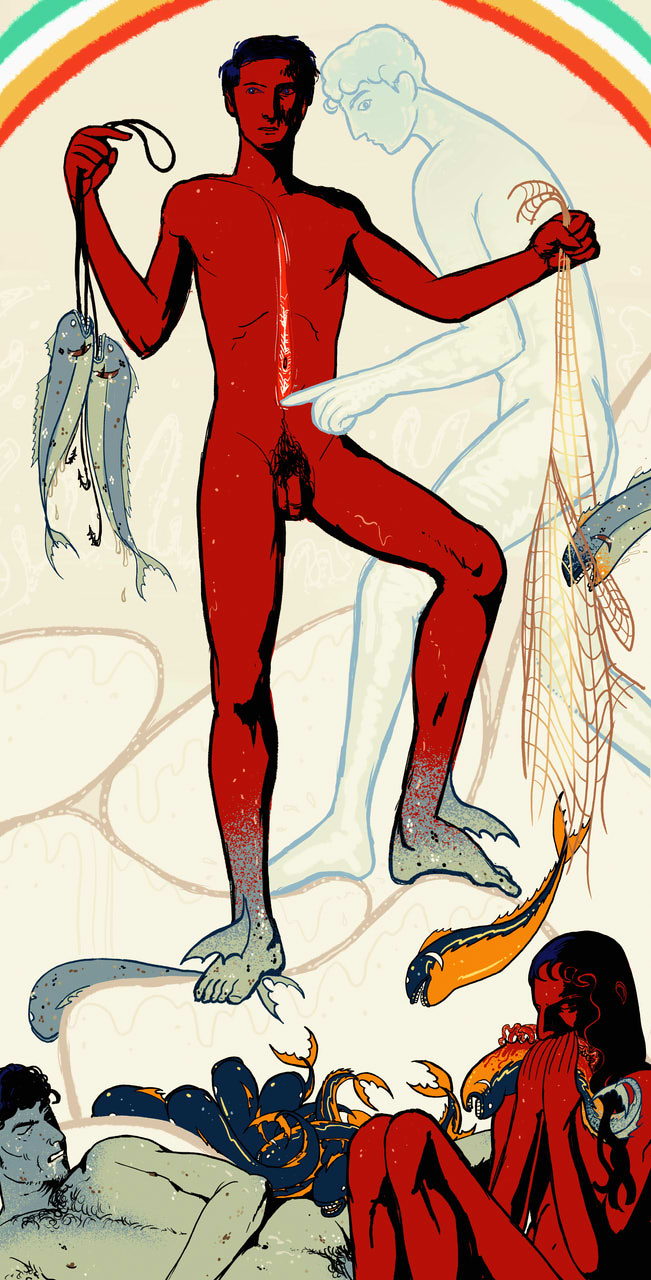
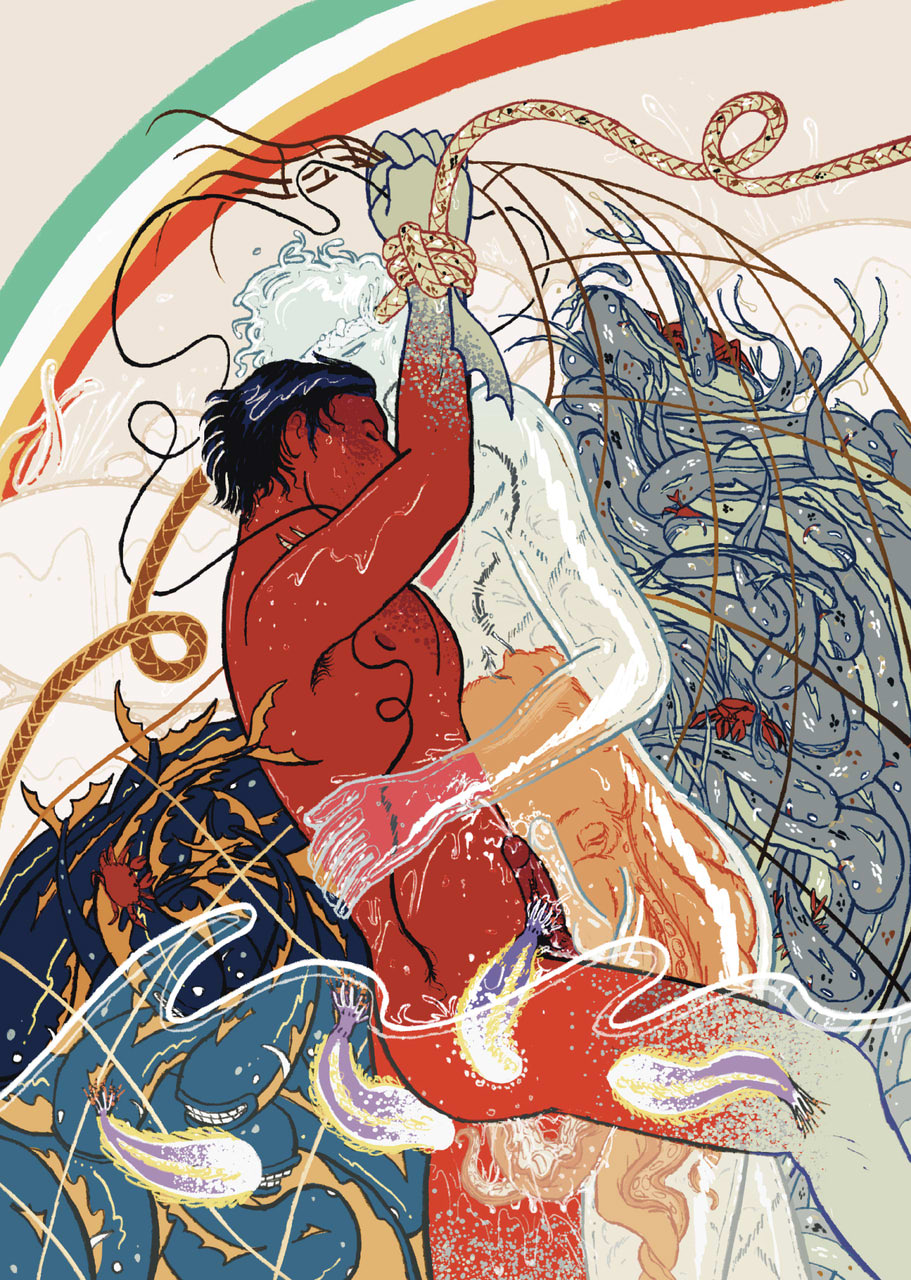
Various drawings for The Golden Net.
Tip: If you don't like reading black text on a white background, try finding a "Reader View" somewhere in the URL tab of your browser. You should be able to change the size and colors of everything there.
The Golden Net is a story I've been writing that takes Peter, Andrey, and Farhad from Pathologic and rebuilds them in a world full of fishermen and shell-divers and sensations and excess and death. It started as a single drawing from 2023 and has since grown into this wild thing you can see here.
I'm not exactly sure how to explain the importance of that link between the existing characters and this original project full of my own ideas, but I will put a pin on that and return to it some day. Hiroki Azuma has an entire essay on this phenomenon (or something similar to it), which I have enjoyed greatly and referenced in an essay of my own about Pathologic... and I still don't know how to articulate it!
Regardless, I think it's worth mentioning so people can finally understand why I keep on drawing Andrey and Peter and Farhad very naked and trapped in nets along with fish. (It's them! But it's not them...)
This post has the first two parts of the story, since the way they set up the story allows for the third and final part to be a sort of meandering adventure of debauchery... that I haven't written yet. I would like to self-impose a deadline for late October where I finish the third part in this writing style (so the completed short story can serve as the "core" of the project), and then after that I can do whatever I want, like freeform writing and images and comics and whatnot. Fingers crossed I meet that goal...
Also, since this is a written story and not something visual, I haven't written out the whole thing in Hharmari and made it impossible for anyone on earth to read it. Instead, the writing style is influence by Hharmari's use of compound words, which appear quite frequently in the second part. (Shoutout to ultra-aquatic-teal-marine...)
I hope you like this little adventure by the sea... Big thanks to everyone who has heard me tell the story in person, and has helped out with suggestion and encouragement.
The Golden Net
Note on Terminology
Here, all shells used in decorative arts are called spondylus (plural spondyli.) Similarly, all sea monsters and inedible fish are called hake (same singular and plural form.)
Part 1: Poisoned Hake
Here is obsession, twisting the world into the shape it wants to see. Here is magic, saving itself from oblivion. Here are the two, coming together. A thing that emerged from the earth and was meant to return to it enters the sea instead.
When Ūne was much younger and healthier, she would run to the fishermen returning from the shallow seas to tell them about Mori, who drew fish into the bright, safe waters they waded in, and also gave birth to the hake that roamed the deep seas.
But green water turned all of the fish into poisoned hake, so the fishermen left.
She ran to the hunters next, who processed the meat, bones, offal, brains, and skins from hoofed beasts, and told them about Perkons, who granted humans the perseverance to track these creatures for days, and also gave the hoofed beasts their strong legs which they used to stride and kick with.
But the beasts became sick, as did everyone who ate them, so the hunters left.
There were still potters and basketweavers, so she told them about Kapnas, who made the clay and reeds they used in their crafts abundant but tedious to process, out of love for watching them slowly make vessels and baskets.
But there was nothing to fill the vessels and baskets with, so the potters and basketweavers left.
The humans left, the land animals left, vegetation and earth dried out, and she no longer felt the presence of Mori, Perkons, and Kapnas, along with Gebt, Nebris, Hūrrnok, and many others. Dhekom, would not abandon her though. She had not seen the rest, just felt them, but Dhekom she had seen long ago, before she felt the rest, and on that day she had knelt in front of her, because she took the image of a naked woman emerging from the sea with a radiant, split hake as a head-dress.
Something in her instantly recognized this image as being worthy of devotion. Kissing her feet and thighs and belly and breasts and face, she tasted brine from the deep sea and blood from the split hake. She knew at that moment that Dhekom needed her as much as she needed Dhekom, as Kapnas hoped humans would make more vessels and baskets and humans hoped Kapnas would give them their materials, as Perkons savored the hunt and the struggle, and as Mori enjoyed light in water dancing across tanned legs and fish scales…
Dhekom returned to her a few more times, occasionally as a distant figure in the water, occasionally by laying next to her as she slept, and exactly in the moments when she had lost all hope of seeing Dhekom again.
"Let me see something beautiful," she mourned to Dhekom, alone, much later, in sickness from eating poisoned hake. "Let me see a beautiful world."
There was one issue. Dhekom had never visited her, because Dhekom was the name of the image of black earth. Dhekom was what everything terrestrial was born out of and where they returned to. Everything that walked the earth was an individual dream from Dhekom, and they faded away when that dream ended. They emerged from Dhekom and were swallowed by Dhekom when black earth got hungry for what left it.
What emerged from the sea and returned to it was a separate matter.
Perhaps isolation and madness had driven the devoted woman to mistakenly see anything that returned to her as being as massive and worthy of devotion as Dhekom. Regardless, she believed what she wanted to believe, a sick mind corrupting names and domains, and at that moment, she was begging for comfort from the only image that ever returned to her.
However, the image before her was growing weak. Mori had already moved on from humans and fish and light in shallow water to lightrays themselves. Perkons had found the pounding of human feet and beast hoofs as they sprinted to pale in comparison to thunder, so he went to the clouds. Kapnas had realized rivers were able to carve canyons given enough time, so he turned his attention to these larger crafts. The image had stayed with a small number of humans, deriving pleasure and power from any kind of devotion: to her, between lovers, from clan-members to a clan-leadress, anything. But her humans were scattering and dying, and some were confusing her for something else. Her name had been lost and soon, her power would go too.
"I will bring you a beautiful world," the nameless image said. "I will take what is mine, and you will see a beautiful world."
The devoted woman reached out a hand to touch a split tail of the hake in her headdress. This half was diseased, while the other was healthy and golden.
"You're sick. I'll give you anything you need, anything at all."
"Yes," the image said. She was not sick. She was hungry. "Everything."
The image entered the devoted woman, cut off her breasts, and ate them. The air seared their shared ribs and heart, blood ran down their body like the blood of the hake had run down the body of the image, and they used the last moments of their dream to walk out into the sea.
Live with me in the sea. I love you. I love you. I hate you. You promised me, you lied to me, you damaged me. Get away, get away. Hurting me, hurting me. I'll find you, I'll eat you, I'll get what's mine, you'll get what you deserve.
Twin-splitting used to be necessary. Not enough food in decades of famine. The weaker one was left at the foot of the mountains for the animals, or in the sea to drown, whichever place was closer. The famine lasted so long that twin-splitting was enforced as law, leading to many more deaths than just that of a single twin in a family, and then un-enforced when food was more abundant again. Quite some time has passed since then, but twin-splitting remains alive in story-memory and visual-memory. Double hakes, one emaciated and one healthy, are as popular visual symbols as the hake that hunts itself. The Golden Net is also one story out of many that carries that memory.
Part 2: Magic Hake
Here are two things that didn't live for long. Here are their half-bodies, decomposing in the sea. Here is the love that gave them new half-lives. Watch them return to land as half-things, then watch them craft new life where it should not exist.
A riptide will lead you across the coast if you let it, and then it'll let go. Most young swimmers don't let it guide them. Some don't have a choice.
Two small bodies decompose in the water. Red flesh, white flesh, green flesh, black flesh. Nameless, placeless, almost dreamless, and unrecognizable. Part of a pair no longer. You remind me of myself, the nameless image thought. Let me see what I can do with you.
The image fed the bodies to her hake head-dress. Gold-green-teal-blue-rainbow-water-shimmer-spin. A single body now, living one dream: but too much flesh, too much need, pointing left, pointing right, not right, unstable, falling apart. How about two bodies sharing one dream instead? When they had drifted to her on the sea current, one heart was stronger, and the other was weaker. One set of lungs held more air, the other less. One drank milk viciously, the other hardly drank at all. So, why not cut them in half and mend them together to create balance? Their eyes, their limbs, their sets of teeth, their scraps of remaining dreams, everything. Shared strength. Shared hunger. A little bit of each in the other now.
The hake was happy with what it had created, and so was the image, until she saw their hair grow, their eyes shine in the light, that curve of their smiles, the soft sounds they made in their sleep… Heart-pinched, lightning-pain, love-lost, rejection. The water reflected two bodies in the future and both looked like one woman.
I want to kill you. I want to eat you. What you said to me— what I did to you— I can't. I can't. I can't. Run away now! Return to the earth! The one thing I really lost, I'll lose again!
Half-things were put back into the earth in a way they would not normally rest there. Dhekom— True Dhekom— liked these half-things, though. They seemed to seek each other, and something more. What a strange force. You remind me of something else, something I can't find… Walk in dreams again and see if you can find this thing for me.
Atan and Kefa were born to the spondylus diver Mirla and the fisherman Imirin, during the time when the flamingos arrived at the southern salt lakes, and when day-fishing and day-diving ceased because of the hot weather. Three things were placed by them in their child-corner, and then later carried with them in their child-bundles: Young prickly samphire to strengthen them against sickness, indigestion, and hunger, a salted hake from the Green Sea to accustom them to the smells from further north, and a red-green king-spike shell to draw them to the beautiful things there.
Mirla and Imirin stayed at the southern salt lakes for two years after Atan and Kefa's birth. The first year, a sea-traveler named Estel came with her child, Miro— just barely of walking age— and stayed with them between the time the flamingos left and then shortly before they came back. Estel was a spondylus-crafter from east of the Tramota mountain range, and her partner, Iru, was a merchant and sea-navigatress who had come primarily to exchange salt lake hake with quartz from the north. Estel and Iru ended up getting along quite well with Mirla and Imirin, and Estel had never been to the Green Sea— where the best spondyli she worked with came from— so, the next year, they came back and stayed with them until they all sailed to the fishing and diving grounds of the Green Sea.
Atan and Kefa were strong on their feet by then, but they still retained some of their strange habits from child-corner age. When Kefa slept, Atan ran around. When Atan slept, Kefa was awake watching the sea. When Atan wanted fish, Kefa sat in silence. When Kefa damaged everyone's hearing with her cries of hunger, Atan held her hand. Then, there was Kefa's habit of occasionally licking the salt off of the hake in their child-bundle, which was not really related to the rest, but quite a cute habit in infancy until it started to degrade the appearance of the salted hake. Mirla and Imirim could not convince her to stop, but Miro told her it was gross in a way only children can tell other children, and then she stopped. (Atan brought her salt-rubbings from her own hake in secret, or as least in much secret as a child could manage.)
The hake-fishers and spondylus-divers of the Green Sea formed seasonal troupes that would mostly be active during spring and autumn, but they also stayed during summer for cross-troupe events like night-feasting, night-dancing, and the ever attractive but dangerous activity of night-diving.
The troupes came from scattered areas across both sides of the Tramota mountains, and even further north inland where snow fell in the winter. To make trading easier, a common, utilitarian tongue had emerged, though the night-dances began using it for rhythmic songs as well, which eventually turned into intricate speak-records and friendly (at least, mostly, friendly) speak-sparring.
For six summers after Mirla and Imirin arrived, the seas were clear, the fish in shallow waters were healthy, and the hake did not encroach on territories they shouldn't. Then: ultra-green, sea-blighting, fish-rotting, hake-summoning misfortune.
Do you remember the samphire on the sandbars? The maritime cardoon, the dune juniper, and the flamingos? Life shimmering in the southern seas? How hake were caught to be used in charms, and not something we'd catch in shovels of sick and sickening fish? I want to go back, Imirin said. On his way to haul nets from a place further east from their normal troupe-ground, he stepped on a new thing, a stone-hake, and: Death, death within sunrise.
Grief did not take Mirla, hake-sickness did not take her, but watching the sea in spite almost did. A year, an eternal year of no diving. No sunlight through clear water. No beautiful red-green things. No Imirin on the rocks, mending his nets, calling out to her. Miro, at the newest troupe ground, chased after Atan and Kefa, and briefly caught sight of Mirla in her grief-corner…
Mirla had lost her half and a larger whole. Imirin had too, since Mirla had not died with him. They had promised to die together in something magnificent like a lightning-to-ship-wreck, or live forever together: a silly wish, but when they'd spoken it aloud so long ago, the sunset cast shimmering-red-gold on the water, and thousands of those migratory birds gathered on the salt lakes…
Live with us. Iru said. Give us your pain. We are strong enough to share it.
…and you still have to teach me how to dive for red-green shells, Estel said, embracing Mirla. Stupid, stupid, stupid… Rotting on grief-land…
Miro understood what he saw when Mirla returned from her first dive in seasons with Estel and Iru. Atan and Kefa too, but it was different: Family-night-feasts were gone, family-stories-under-stars were gone, father-net-mender chasing and running around and laughing was gone, Mirla was almost gone, but Miro was there, chasing them around, and then there were the big-night-feasts with thunderous-night-dancing, and the Miro-family-night feasts, and pretty things spoken rhythmically with one-unusual-now-normal words, and look, Estel and Iru and even Mirla were all back. So, things changed. Death was new, but not unusual, too: Miro had told them about before-Iru and how ships crashed where Tramota met the sea. A story of death that Estel had told to him, and now that he had passed on to Atan and Kefa, which had shielded them just a bit from the first full strike from the sea.
Flamingos flying overhead, going south. Mirla brings everyone to the diving-grounds for the first time then.
"This diving-ground is strange now, and fishermen like casting their nets over there more," Mirla points far across the shore to the east, "but there are still many shells here. Somehow even more vibrant than before… Follow me, and shuffle your feet to warn the stone-hake, though they shouldn't be here…"
Atan looked to the fishing-grounds, while Kefa and Estel watched Mirla. Iru stayed on shore, mending a rope-sewn boat.
The diving-grounds were rainbow-illuminated-green, and king-spike shells grew in vicious numbers. Small multicolor scallops darted short distances and then changed their minds. At night, the luminous-blue specks that called night-divers to their deaths were now tinged green, sometimes violet, sometimes even ultra-red. Black-jagged shells were more lustrous, like faraway obsidian, but also more dense, like dead-torch-cave-air-black. Nacre cast double-shimmer, triple-light, ultra-aquatic-teal-marine, stronger and thicker, yet somehow like a perfect layer of thin waves frozen in time. Intoxicating. Impossible. The night-divers… The night-lovers… Blood for colors memory can't hold. Do you understand now?
A chief from the north had his neck snap when he placed just one more ultra-aquatic nacre statuette in his mega-mega-head-dress of war. The only thing keeping you safe is that it's so normal here… Not so impressive.
Atan asked if he could go mend the ship with Iru, and ran off. Estel got a king-spike shell, but not a red-green one, rather one with green-blue-white variegation. Kefa didn't pick anything up, too busy looking at the light underwater, but dived for so long that Mirla chastised her when she came back for air.
Night-feasting came with friendly sea-exchanges and speak-sparring. Estel had begun breaking down the king-spike shell, and let Miro trade bits of it with other kids. A stone for me, a shell for you, a fin for someone else, fragments of the variegated sea on land.
Life was fine. Winter, they returned to the southern salt lake, spring through fall they returned to the Green Sea. The past can always be returned to, but the one you love(d) isn't there anymore, so at some point, everyone stopped. East-east, though not as far east as the south salt lake was far south, was Miro and Estel and Iru's little place on the coast. There they went from now on during the winter, and learned yet another way to speak. So that's why they say things a little wrong like this, or why they pause to think by saying that…
Then, at 12 years, things changed for Atan and Kefa again, a lot, and it wasn't fine, but Miro explained things to them like he had when death happened, though this time not early enough. In a span of four months, Atan was no longer like Mirla, more like Imirin had been, and in a small matter of time, the same happened to Kefa as well. What was happening? How could this happen? Well, in truth, maybe this hurt less to Atan, the change became exciting, but it was not to Kefa. Miro did his best to explain that sometimes it happened by nature, like with before-Iru, or by choice, like with Iru, though in Iru's case, it was the choice to become what nature had made Estel. The latter made sense. Choice happened all of the time. He never quite answered why things happened "by nature", though… What are nature-choices? Why does nature choose for you? All of the nature-choices they had ignored so far, brought to the forefront.
Kefa rubbed the coarse hairs at her chin, frustrated. Atan asked for an ultra-aquatic-teal-marine blade from Estel, and shaved the awful things off of his (now his) own face, then cut his hair shorter, shorter, shorter, so short. Kefa tried it once too, but it was devastating, losing this thing that framed her face like Mirla's hair did, and then she always cut her chin shaving the awful coarse hairs, and didn't like it when Atan helped her, so she stopped, and then at some point hated being so close yet strangely far away from Atan that he decided to give in and say he was something else now, like Atan, who casts nets and grows golden and strong under the sun, even if Kefa was not as beautiful and capable and had all of these mis-mashed features from the non-past and non-future and non-present. Lost: what I thought I was, what I thought I would be, what I am now.
Miro did what he could, since it seemed peace was attracted to him and repulsed by Atan and Kefa. Let's mend nets with Ekil from the troupe just east, so you can bring them out to sea with him, he said to Atan. Let's dive with Mirla, and I'll be your watcher, he said to Kefa. With Estel and Iru he crafted nacre blades and built nets with cork floats they had gotten by trading obisidian-deadnight shells.
Kefa brought him unusual gold-curl queen shells, and he wove those into decorative shawls repurposed from frayed and unsalvageable nets. The shells caught the light in his hands and he said, Kefa, try this on, so he did, and he spun around, and his long hair shone with droplets of water, and the golden shells caught the light, and the nets draped over his thin body, and they were thick like wet sand drips when they bunched up, and airy like meduza-tentacles when they flowed out, and he was beautiful. Sick, hake-rot, lightning-reach-out-no-no-no. Follow, follow, eyesight. Internal voice. You're beautiful. You're beautiful. I'm sorry. Internal-unspoken-silence. Watcher by the beach suffering, the turn, the turn, the turn, vomit, peace repulsed by him, what did I do weaving shells into nets….
Gold poison. Fall in love with something bigger, now. Sunrise, sunset, one season, one year. Two years. More years. More years. Sail east then back then east then back and now here again at the Green Sea.
Atan casts nets even further east from where Imirin died. What a shame. Such a long walk from the diving-grounds now! The west was still good, even better, for spondyli, but here were the fish… and the deeper-sea hake, which had become valuable like spondyli, as they were used in salted ornamental head-dresses and hake-skin adult-bundles. Atan had an adult-bundle of his own like this, and the tough, brown-gray skin had nacre and scales woven into it, so it caught the light and reflected ultra-aquatic-teal-marine.
Miro built him billowing, Tramota-wide nets for the fish in the shallow seas, and then bristly, rough nets with cry-of-midnight-sharp shards embedded in them for hunting hake. Hoof-beast bone harpoons too, and heavy-dark-wood clubs for bludgeoning what couldn't die when caught or pierced.
"I'm going to need something cover myself with, look at how they fought me," Atan showed Miro the hake-lashes and hake-bites across his arms and chest and back. Miro built him hake-skin tough-wraps for his body, and hake-skin patchwork-blankets for rolling up hake in and carrying on his shoulders.
The sea carried salt on the air and sand carried heat to the nose. The rocks, though… The rocks carried high-acid noxious rot, putrid wet-body rot, body-expulsion rot, stick-on-hair-and-throat rot, and squelch-rot came from where the fishermen disemboweled inedible hake. Blazing sun and humid nights spent doing this, waves washing long-tripe and short-tripe and bone and yellow-black-red-green-gray blood to the sea. A color like the sick fish near the diving-grounds, just stored inside a larger body. Maybe the hake ate sick fish and grew stronger, untouchable. At least someone could eat them.
Kefa scrunched his face when Atan returned at break of morning from the blood-bath at the hake-rocks, and washed his hair with boiled water from the clean-river mixed with bitter-fresh soap-plant, sour-bitter coriander, and sweet-cutting quarter-stem-of-crocus every single time. The crocus stained the hot-river-water yellow, bright yellow, like urine, but sweeter, though it was hard to see the color as it ran down Atan's sun-dark-gold-red skin.
Miro built a lot of things for Atan, but he also built things for Kefa. Kefa had brought him ultra-rainbow-shifting nacre, and when he filed and polished it to be as thin as hake-scales, it surprised him to see that water was invisible through it. The light on the surface that dazzled and obscured everything was gone! He showed Kefa this, and they took turns looking through it, then not through it, then through it, in quick succession. How could this be! They laughed. Kefa brought him more ultra-rainbow-shifting nacre to see if the magic could be repeated, and it could. Kefa dived for shells while Miro watched him, exposed in the sea. Miro offered the magic to Atan, maybe in the form of something he could wear on his head, but he said no. It could break during a struggle and cut or blind him, he thought. The hake thrash and whip too hard, and the nacre is just not strong enough for that. It could be useful to scan the water for hake, though… but something to protect from whip-injuries to the eyes would be better…
A younger hake-fisher brought along the magic-nacre that he traded from Miro, and puked yellow-yellow sour bile when he saw the masses of hake squirming and tearing apart a bird that was dragged below the water. Red-cloud, frotting-tearing, feathers, splash. The water was so dark and deep too, so… better not to see more than the surface, and what your hands could reach.
For himself, Miro built a few things. Little bone hooks to catch fish, branch-and-net traps that let fish come in but not out, and clothing with bits of inoffensive shells to adorn them. Things with limited utility and trading value. The gold-curl queen shells called to him, though. He had many fragments left, and maybe in small portions, they would not dazzle and sicken him like on the day with Kefa's net-shawl. He made hooks with gold-bobbers and cast a line out from shore. He did not know that the spot he picked had sick fish in it now, and had no way of learning it when one bit his hook, because what he brought in was healthy, oil-slick, clear-eyed, and fat. Quick death, cast hook, bite, bring in, repeat. So many fish. Enough. No more.
"Look, this is my best haul yet. Beautiful things love me," he boasted to Atan, and they walked to the sunset-shore with firewood. The dying light showed rich red flesh when cut open, clean long-tripe and short-tripe, and removing the scales with a nacre knife was easy. This was red-fleshed prince-fish, Atan identified, which was uncommon but not impossible to catch here. It was the fish served to welcome in new troupe-members, to celebrate first loves, and strengthen a mother after the birth of a child. However, it was also eaten by fisherman who could catch it more freely, since it was just a good meal for before-and-after long hauls. Kefa joined them soon after, nearly dry from diving since the walk was so long. Sunset-blaze-then-dark. Let's go night-diving for a bit, in the luminous cove, and then walk back home. Still a little humid, still a little warm, lay in the sleep-tarp scattered and naked and full and happy, thunderous-dancing-and-singing finally ending outside. Dream, dream a bit, see through clear water, little scallops darting, colorful and and aimless. Wake up when the light comes in, and just before the sleep-tarp becomes impossibly hot to stay in. Another day.
The only thing that ruined Atan's beautiful mood was a hake wrapped in a patchwork-blanket that he had forgotten about. The sun had rotted it, making it a wet, hot, slimy, gray-green-red-black mess. Its belly bulged with death-gas and was ready to explode. He grabbed soap-plant, coriander, and crocus, wetting a cloth to place over his face, and took it to the least used hake-rock. Plunging in a needle-knife to de-gas it, thick plumes of death-clots, spluttering with death-gas, emerged from the puncture-hole, but the pressure he had placed on the belly also caused the sickness to emerge from every body-hole. Black, brown, yellow, red, white, even torrents of little sick fish... Like the plague that caused relentless defecation, relentless dehydration, relentless starvation, until all that came out of the body was white mucus, and the last breath of life. High-acid-thick-sunblaze-orifice-expulsion-cloud reached his eyes and nose and tongue and throat and lungs, and tears dripped down his face. Ultra-marine-stench transforming ultra-aquatic-colors before his eyes, brilliant gleaming rot blinding him for a heartbeat, then turning slate gray and real. Turning, turning, nausea. Disgusting. Disgusting. Unreal. He gritted his teeth and slashed the thing to pieces. Forget you existed. Brown-black-red-green-white clots across his arms and chest. The water washed the hake away, washed everything off of him but not the stench and internal rot, and, and, and, retching, hateful, he walked far inland to find a clean-river to forget himself at.
Miro had great success catching prince-fish with his hook, so he told the other fishermen about it. They looked at him strange. That isn't a good shore to fish from, but we'll go with you. He brought his little bone hook, even if the pretty golden bobber attached to it had started to break a bit. He caught some good fish, a few okay ones, but the other fishermen only got nets of rot. It wasn't remarkable; sometimes prince-fish swam through low places. But that wasn't right…
"I realized it when I made traps woven with gold-curl shells," Miro whispered to Atan. He brought him to a secret river where he had set a trap. "Look."
The trap was filled with good fish and sick fish. The good fish thrashed and pushed the sick fish against the golden-glimmer-shards. Little abrasions, frotting-tearing-skin, magic. The trap burst with good fish now, and they hurried to bring it on land. Quick deaths, quick deaths, but some escaped back into the water.
Kefa and Miro laughed whenever they witnessed magic, but Atan looked like a hake-fisher scanning the sea. Stormy day, swarmed by monsters, rocked by waves into nausea… Then, there was the Ultra-Rot from the hake-rock, the little sick fish trapped in it… The good-sick fish in his body from that sunset-feast…. Night-diving with Miro, Kefa close by… He keeled over.
"This is good, you can catch good fish where there are none," Miro said, unsure of how to comfort him. Atan didn't get sick, he got angry, or he got to work. Why was he keeled over now…
"I can, but," he paused, swallowing bile. "Only if you keep a fish alive for me a whole season, then kill and salt another, and smoke a third. I… I need to know… that the rot won't come back."
"I can do that," Miro said. "Anything you want, I'll give you. Anything you fear, I'll prove is safe. You'll see these nets are good."
Anything. Anything. Anything. Permissive, forceful anything. Season of watching in anguish, fears never coming true. Cold feeling inside. Awful miracle. Now cast nets and catch life where it shouldn't exist. Reel in beauty instead of rot, I hope it's beauty and not rot. Begin the end.
Notes on Depictions of the Golden Net
When gold-extraction and gold-violence increased, the Golden Net started to be represented as being made of pure, elemental earth-gold. Before, it was net-twine with various decorative shells, gold being only one of many colors on it.
Part 3: Net of Rot
The half-things cast a golden net in a sick sea with sick fish, and it turns every rotten thing that enters it into something beautiful. Now, turn your attention to the third man who helped them craft the golden net. Life that should not exist, life beautiful as this, where does it come from? Hunger for beauty opens its mouth. Swallow. Silence.
You've reached the end of what has been written. Thank you for reading.