
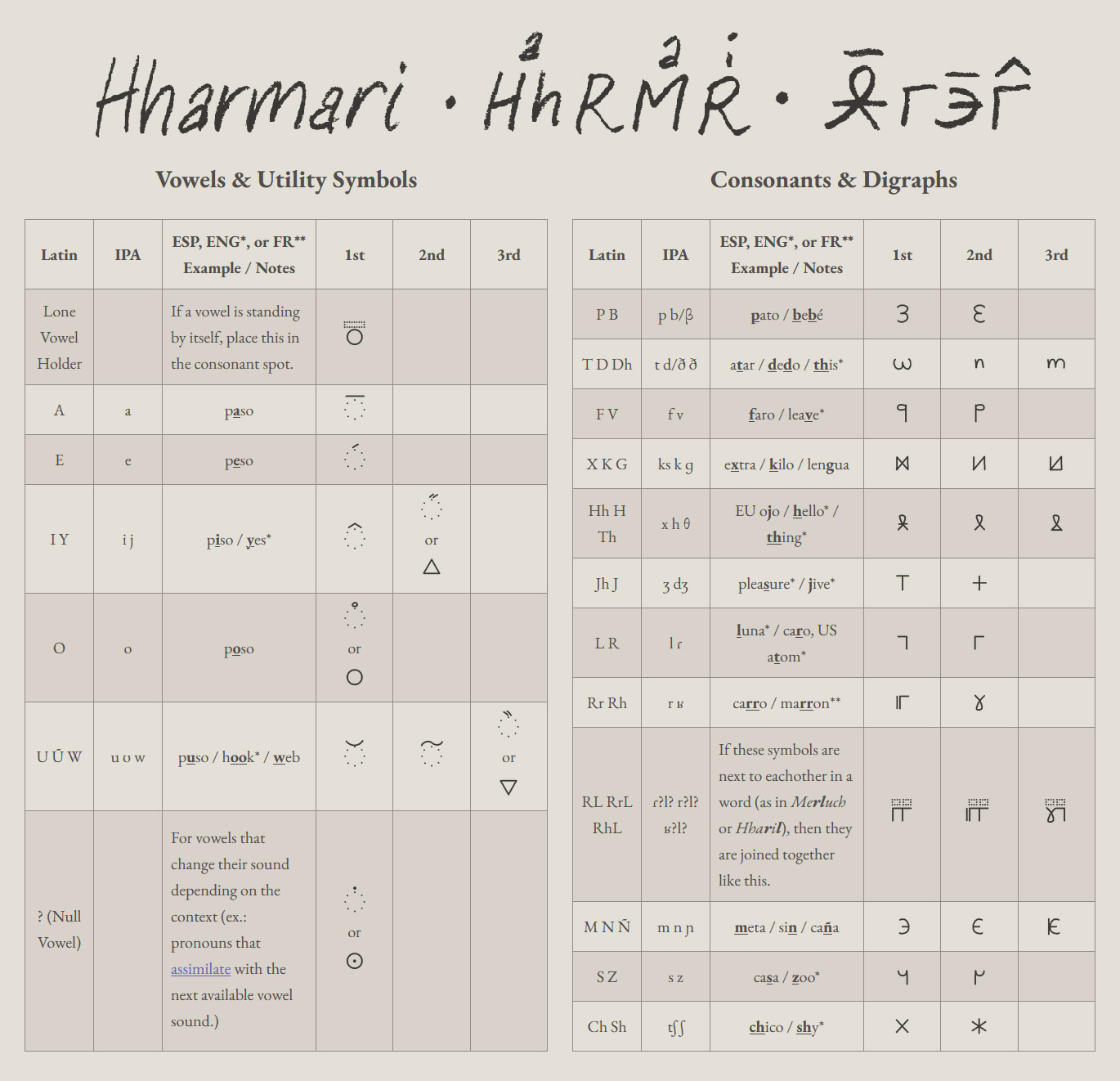
Latin linear, Latin stacked, and Hharmari script.
Hharmari uses an abugida, so vowels are placed as diacritic marks above consonants. They can also stand by themselves if placed over an O shaped "lone vowel holder."
Update Log (Newest: )
 .
. (previously
  ).
). (previously
  ).
). (previously
  ).
).
Vowels & Utility Symbols
| Latin | IPA | ESP, ENG*, or FR** Example / Notes | 1st | 2nd | 3rd |
|---|---|---|---|---|---|
| Lone Vowel Holder | If a vowel is standing by itself, place this in the consonant spot. |  |
|||
| A | a | paso |  |
||
| E | e | peso |  |
||
| I Y | i j | piso / yes* |  |
  |
|
| O | o | poso | |
||
| U Ũ W | u ʊ w | puso / hook* / web |  |
 |
  |
| ? (Null Vowel) | For vowels that change their sound depending on the context (ex.: pronouns that assimilate with the next available vowel sound.) |   |
Consonants & Digraphs
| Latin | IPA | ESP, ENG*, or FR** Example / Notes | 1st | 2nd | 3rd |
|---|---|---|---|---|---|
| P B | p b/β | pato / bebé |  |
 |
|
| T D Dh | t d/ð ð | atar / dedo / this* |  |
|
 |
| F V | f v | faro / leave* |  |
 |
|
| X K G | ks k ɡ | extra / kilo / lengua |  |
 |
 |
| Hh H Th | x h θ | EU ojo / hello* / thing* |  |
 |
 |
| Jh J | ʒ dʒ | pleasure* / jive* |  |
 |
|
| L R | l ɾ | luna* / caro, US atom* |  |
 |
|
| Rr Rh | r ʁ | carro / marron** |  |
 |
|
| RL RrL RhL | ɾ?l? r?l? ʁ?l? | If these symbols are next to eachother in a word (as in Merluch or Hharil), then they are joined together like this. |  |
 |
 |
| M N Ñ | m n ɲ | meta / sin / caña |  |
 |
|
| S Z | s z | casa / zoo* |  |
 |
|
| Ch Sh | tʃ ʃ | chico / shy* |  |
 |
You can read more about the language that uses this writing system here.