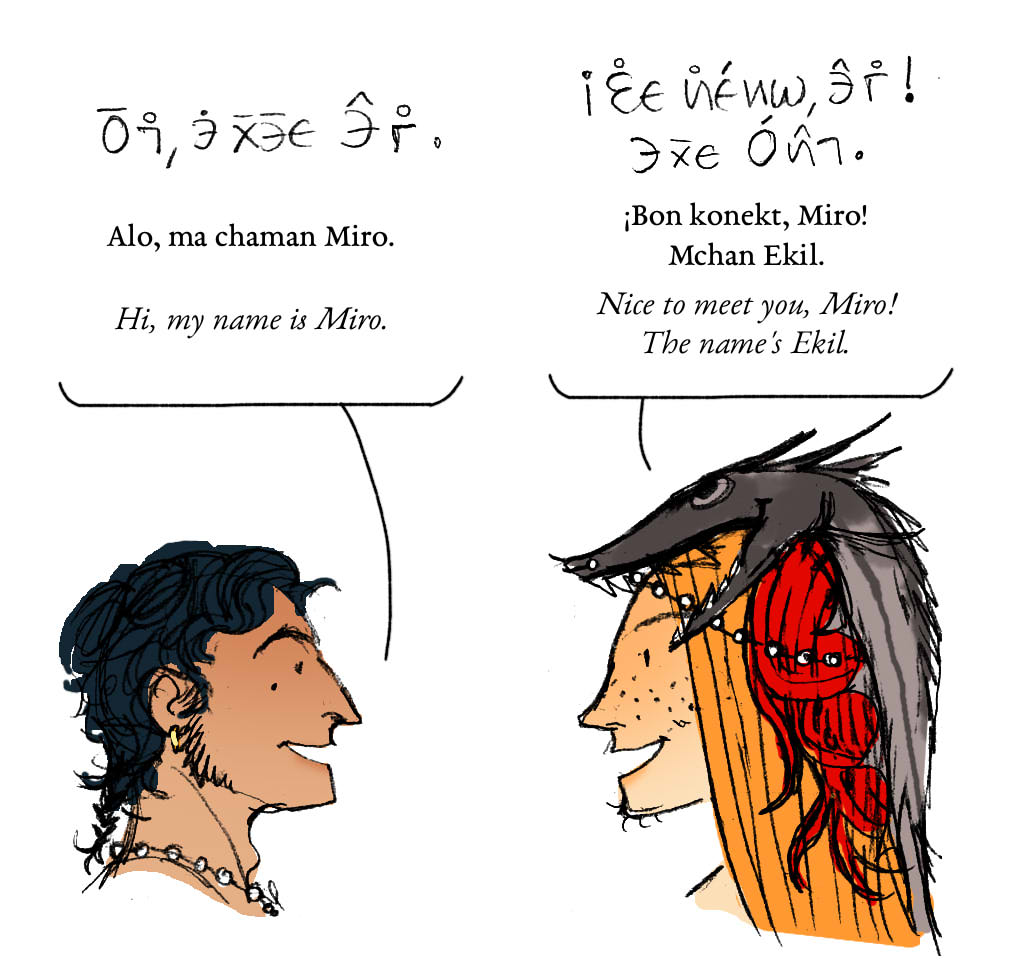
A conversation in Hharmari.
In The Golden Net, Hharmari is framed as a current day creole language that was born out of a much older pidgin language. This pidgin language was used in trade by people who fish, dive for shells, and craft things in a fictional version of the coastal areas around the Pyrenees. In certain ways, it's similar to Sabir!
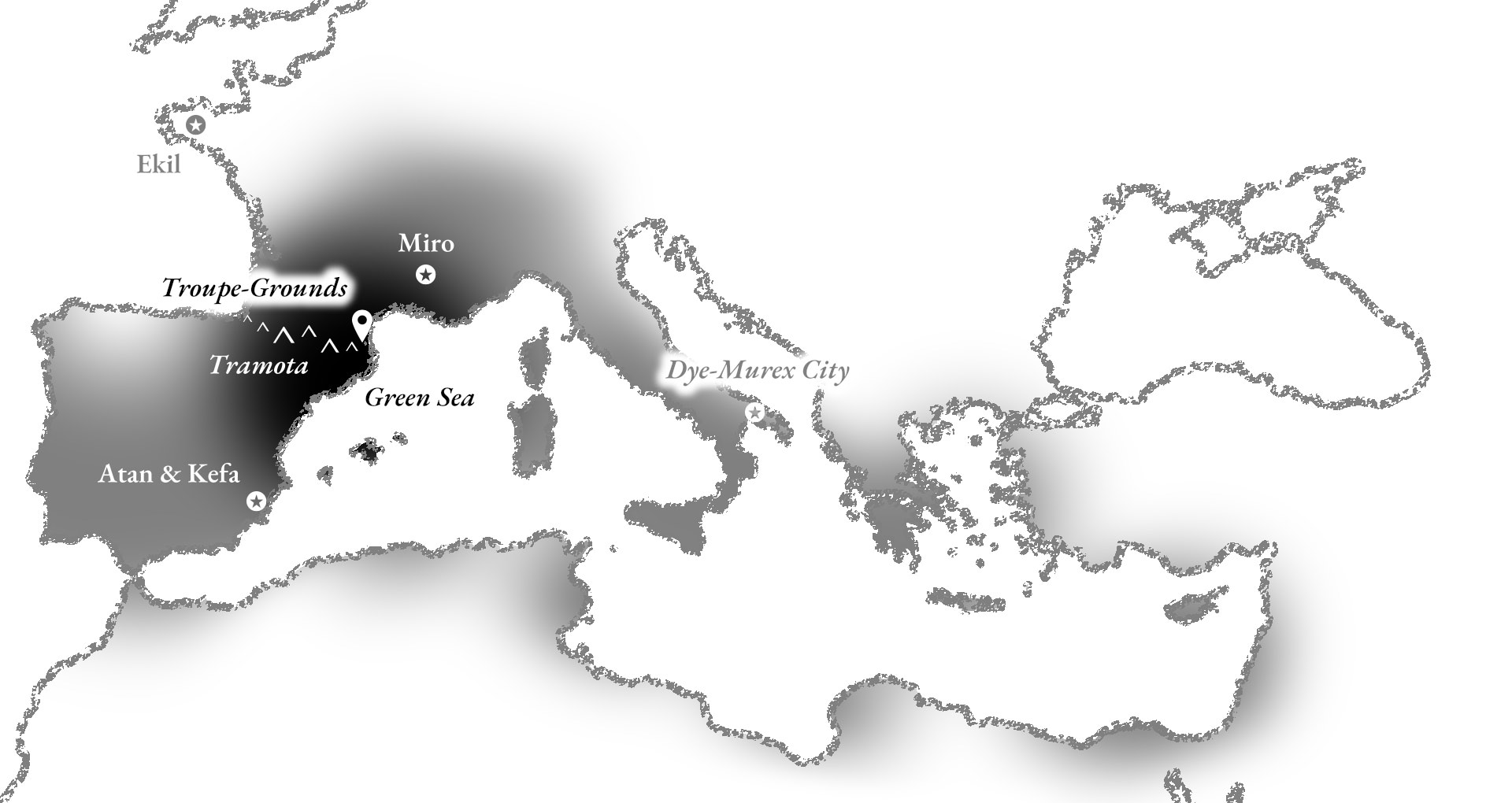
Historic trading areas, with the coast of the Green Sea highlighted in black.
The language mainly pulls from Spanish for its grammar and phonology, and Spanish, Basque, French, Catalan, and Occitan for its vocabulary and use of ideophones. It also has some staple features from other languages, like logograms and large compound words, both ones that have arisen naturally, and ones used for artistic effect.
(In a realistic version of the Mediterranean from a few thousand years ago, Hharmari would not exist. Its Romance-language precursors either hadn't arisen yet, or in the case that they had and/or the Roman Empire was a significant force in the area, Latin and Greek and Arabic would have been used as the major languages for trade. However, the world of The Golden Net was intentionally "built wrong". The languages and civilizations in the story have developed in ways that should appear non-linear, stitched-together, and hyper-accelerated to modern readers.)
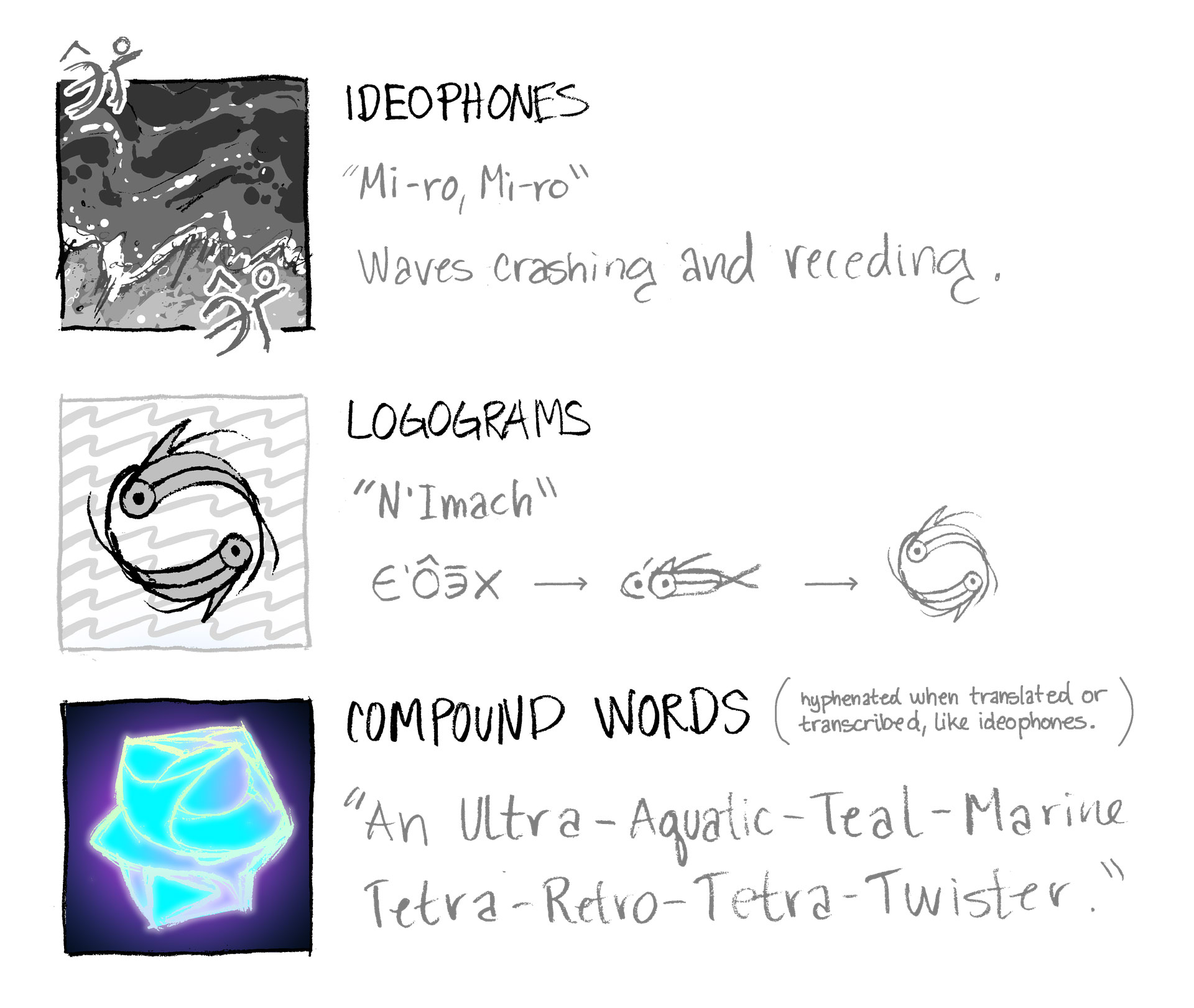
Examples of ideophones, logograms, and compound words in Hharmari.
The story text uses the language a little bit, but not to the point where you'd need a dictionary handy. Instead, when it is used directly, it emulates the difficulty of trading with someone who does not speak the same language, and in the cases when it is used indirectly (as in, English text written in a Hharmari "style"), the focus is on mimicking the rhythm of the language though the use of compound words and ideophones. Those characteristic features of Hharmari help make the sensory descriptions more vivid, strange, and kinetic.
Some artwork titles are also written in Hharmari, like Hharil d'Ex, Term d'Uta, and Ne merluch k'z'ehhisa, and certain logograms of character names appear within the artworks themselves.
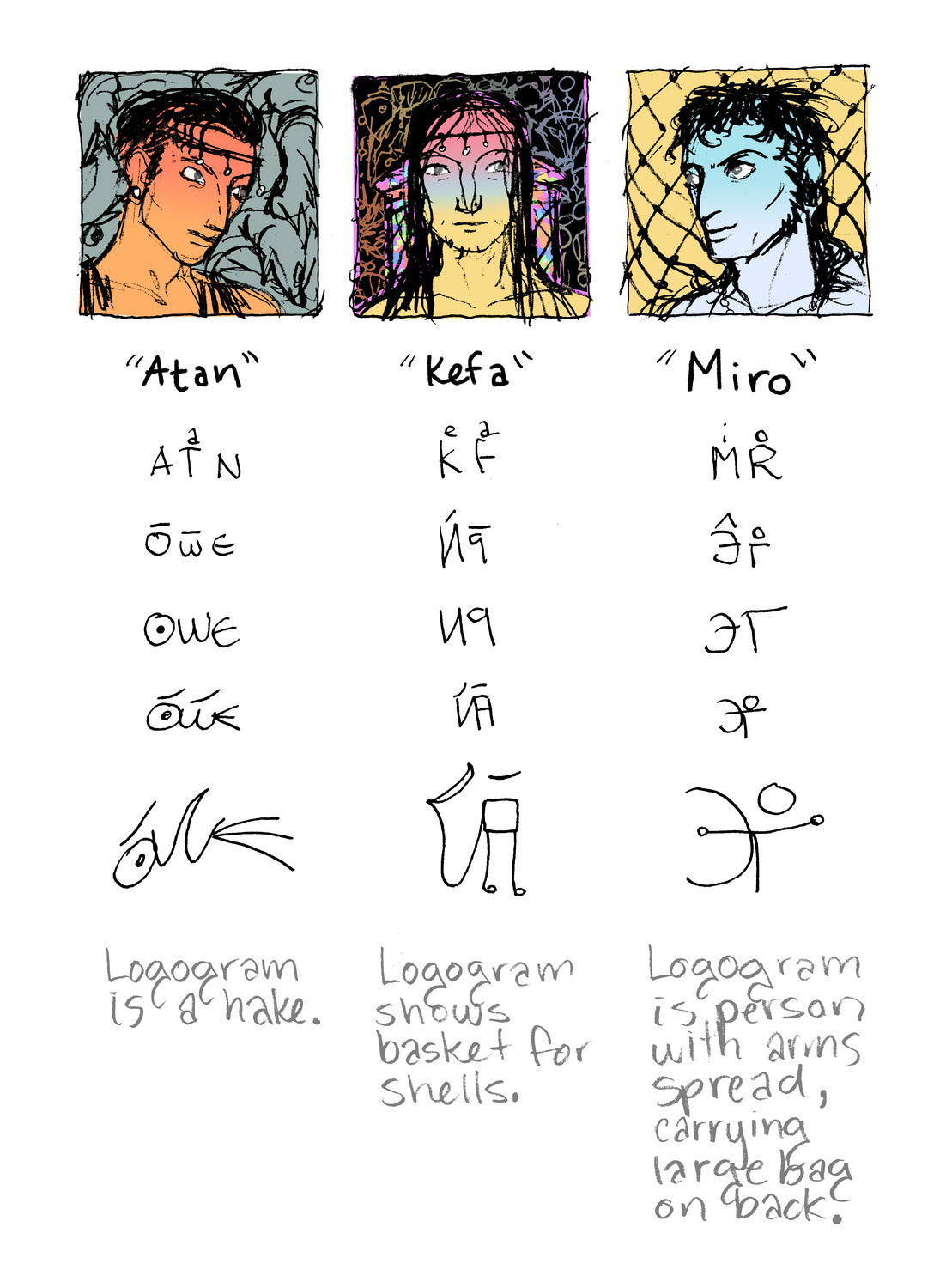
Hharmari logograms.
Aside from one word [n?(s)], there is no dictionary or hard-and-fast rules for how Hharmari should be constructed. Instead, the language is invented intuitively.
When Judas Salieri wrote a short story for the The Golden Net, this was the loose guide I gave him for inventing things in Hharmari:
- It should sound like a Western Romance language with some Basque words thrown in there.
- Occasionally, the people who are from Fake France (Miro and Ekil, mainly) should say French sounding things (like d'ako for d'accord.)
- When it and any other invented languages are used directly, it should (for better or worse) emulate the feeling of talking with someone who doesn't speak the same language, or doesn't speak the language with the same proficiency.
With this, he was not only able to invent sections in Hharmari, but also sections in Greek-based languages used to the west of the Green Sea.
One thing that does have a more thorough guide is the writing system used for Hharmari. Here's the page with all of the symbols used in Hharmari script.