
Hharmari Writing System
Archived post from
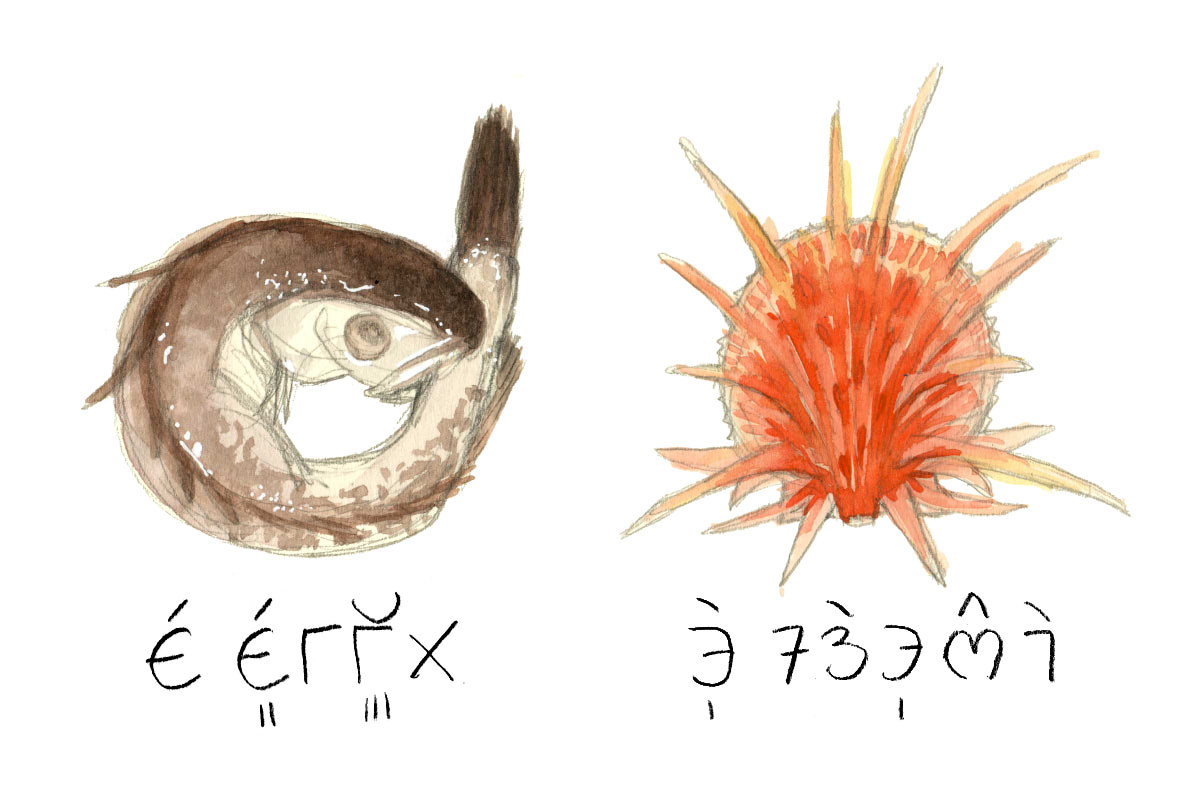
Hake (ne merluch) and spondylus (no spondilo) written with Hharmari script.
Hello, reader! The Hharmari writing system has received a major revision, as a well as a new home on the web. You can check it out here.
This previous version (which includes the old blog theme) will be kept available here for posterity.
I've been making a writing system and language for fun, mainly to use on a project about some made up fishermen and seashell divers. This is the first draft!
The Hharmari writing system uses an abugida, so instead of having individual letters for the consonants and vowels, they're sort of grouped together into one symbol. The consonants tend to be the primary visual part, and the vowels are usually written around the consonants somehow, whether it's before, after, over or under them. They may also modify the shape, rotation, and direction of the consonants.
In my writing system, vowels and consonants can written above consonants as diacritics, or as I like to call them, "little hats." Consonants and vowels can also stand on their own. To show how that looks, here is the word "Hharmari" in a Latin linear transcription, then a Latin stacked transcription, and finally in Hharmari script.
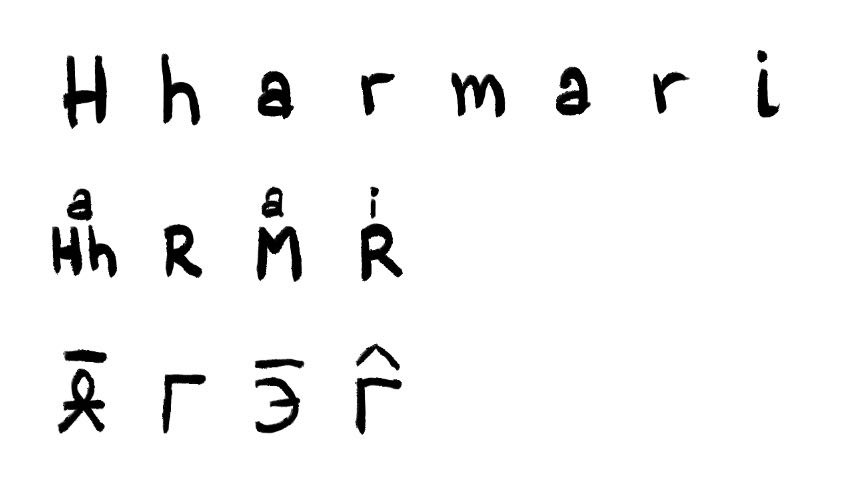
(The Latin linear transcription is the easiest to read if you're not familiar with Hharmari. Meanwhile, the Latin stacked transcription helps your visualize what is going on in Hharmari script, while still being somewhat easy for everyone to read.)
Hharmari can be used to represent many sounds from Spanish and English. The "alphabet" for it is also arranged into groups of 2 or 3 similar sounds. To make this easier to visualize, I've arranged all of this information on a table.
On the left is how you would transcribe each Hharmari symbol in Latin script. Then, there are the IPA symbols for them, and a Spanish or English example of how they would sound. Finally, you can see the Hharmari letters in the columns labeled 1st, 2nd, and 3rd. These slots represent a "form" in a sound group, and later, I'll show how and why you can switch between one form and another when writing.
The dotted line circle ◌ represents the spot where the primary, non-diacritic symbol goes, which is either a consonant or a solid line circle that is used as a "lone vowel holder."
(Mobile users may have to scroll right to see the entire table.)
| Latin | IPA | Spanish/English* Example | 1st | 2nd | 3rd |
|---|---|---|---|---|---|
| A Ai Au | a aɪ au | paso / price* / automóvil |  |
 |
 |
| P B | p b/β | pato / bebé |  |
 |
|
| T D Dh | t d/ð ð | atar / dedo / this* |  |
 |
 |
| E Ei | e ei | peso / rey |  |
 |
|
| V F | v f | leave* / faro |  |
 |
|
| K G | k ɡ | kilo / lengua |  |
 |
|
| Hh H Th | x h θ | EU Spanish ojo, Scottish loch* / hello / thing* |  |
 |
 |
| I Y Ih | i j ɪ | piso / yes* / sing* |  |
  |
  |
| X J Jh | ks dʒ ʒ | exit* / jive* / pleasure* |  |
 |
 |
| R Rr L | ɾ r l | caro, American atom* / carro* / luna* |  |
 |
 |
| N M | n m | sin / meta |  |
 |
|
| O Ā Ū | o ʌ ʊ | poso / sung* / hook* |  |
 or or  |
 or or  |
| S Z | s z | casa / zoo* |  |
 |
|
| U W | u w | puso / web |  |
  |
|
| Ch Sh | tʃ ʃ | chico / shy* |  |
 |
|
| Ny Ng | ɲ ŋ | caña / sing* |  |
 |
|
| Lone Vowel Holder | Used if a vowel is not above a consonant, and the vowel does not have a non-diacritic form. (Only Y, Ih, Ā, Ū, and W have non-diacritic forms.) |  |
|||
| Form Modifier | Optional, used to change the pronunciation of a letter to another form if the shape of the "wrong" letter is subjectively more pleasing in context. |  |
 |
 |
Generally, you want to have a consonant as the main symbol, and then a vowel stacked on top of it. You can also stack consonants on consonants. However, you shouldn't stack anything on vowels, as this will create stacks that are too high.
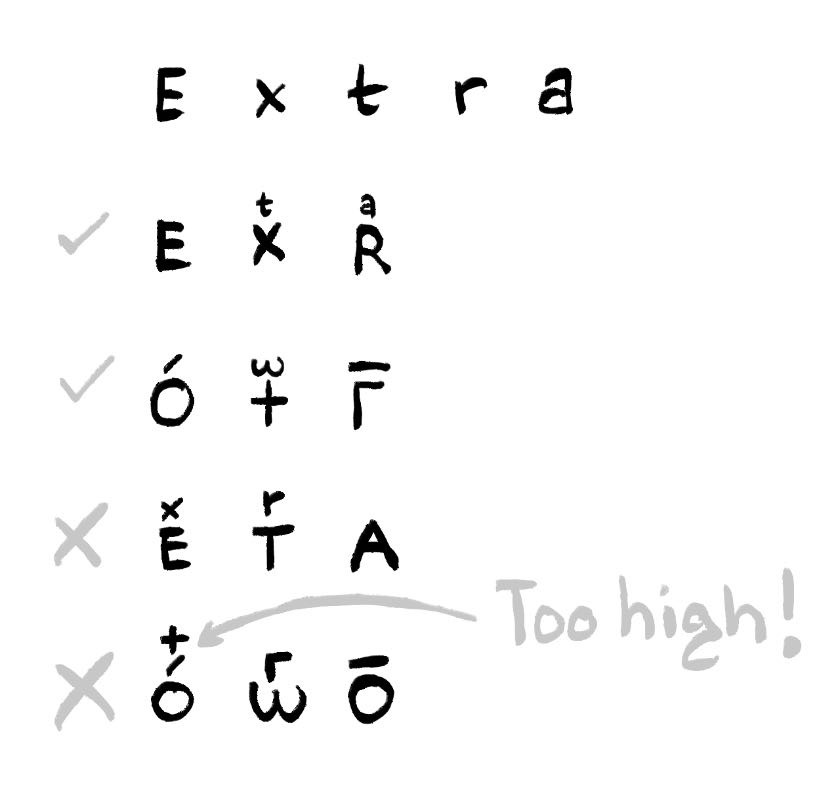
(Here, you can see the right way to transcribe "extra" into Hharmari, and the wrong way. Since vowels have a "lone vowel holder" in the main spot, and then a little hat above them that represents a vowel sound, anything stacked on that hat will go over the height limit of the letter.)
Aside from that rule, how you choose to transcribe words is up to you. You can transcribe them phonetically, or you might find it easier to transcribe things as they're written, so they look like a disemvoweled version of the source language.
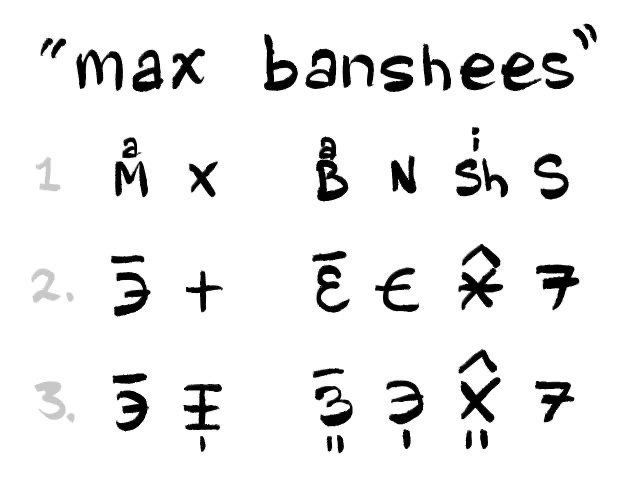
To wrap things up, here is my username transcribed phonetically in three different ways. The first one is a Latin stacked version, the second one is Hharmari with unmodified forms, and the third one is Hharmari with forms that have been modified so that the curves of the letters all point to the right, and so that the form modifiers under the letters have a "1-2-1-2" visual rhythm.
I'll need a whole different post to talk about the Hharmari language. However, I will say that in the story, Hharmari is framed as a current day, stable language that was born out of a much older pidgin language. This pidgin language was used by fishermen, seashell divers, and people who traded with them in a sort of fictional version of the coastal areas around the Pyrenees.
For that reason, the language pulls from Spanish, Basque, French, Catalan, and Occitan for its vocabulary, though it occasionally has some Germanic weirdness. Spanish and English are the languages I'm most familiar with out of all of these, so, in turn, the sounds and (... very on-the-fly invented...) grammar for it is based off of Spanish, though it can feature certain very Germanic things like compound words (both natural ones and ones used for artistic effect.)
Anyway, I hope you enjoyed this little invented script, and that it gives you some context for the weird titles some of my new drawings may have, ex.: Hharil d'Ex, Term d'Uta, and Ne merluch k'z'ehhisa. (Woah... There's some elision in there...)
Thanks for reading!
Edits
- 2026/09/24: Added a note about the Hharmari language at the bottom.
- 2026/09/24: Table is now full height as opposed to 300px.
- 2026/09/24: Latin transcriptions for ʌ ʊ where changed from A' and U' to Ā and Ū.
- 2026/09/24: Article was edited to sound better when read aloud.
If you liked this post, you can leave a comment in the guestbook.